Recommended citation
Timothy F. Harris, Kenneth Troske, and Aaron Yelowitz. “How Will State-Run Auto-IRAs Affect Workers?” The Journal of Retirement 6(2) (2018): 27–33. https://doi.org/10.3905/jor.2018.6.2.027
Peer-reviewed publication · 2018
Timothy F. Harris, Kenneth Troske, and Aaron Yelowitz
Timothy F. Harris, Kenneth Troske, and Aaron Yelowitz. “How Will State-Run Auto-IRAs Affect Workers?” The Journal of Retirement 6(2) (2018): 27–33. https://doi.org/10.3905/jor.2018.6.2.027
Timothy F. Harris, Kenneth Troske, and Aaron Yelowitz
The Journal of Retirement, Fall 2018, pp. 27–33.
Published article. The three original exhibits are reproduced as source images. Read the published PDF.
Amid concerns that individuals inadequately save for retirement, many states have considered legislation to create Auto-IRAs (individual retirement accounts) that automatically enroll individuals who work for employers without retirement plans into a Roth IRA. Since 2012, 40 states considered the feasibility of auto-IRAs, five states have enacted such legislation in the form of employer mandates, and one state has implemented a plan. In 2017 alone, 23 states and cities considered Auto-IRAs (Massena 2017). These plans would use a combination of default enrollment and investment choices, along with automatic escalation of contributions to increase total retirement savings (Madrian and Shea 2001; Thaler and Benartzi 2004; Chetty et al. 2014). While the arguments for such a program have been well-discussed (e.g., Benartzi and Thaler 2013), there is scant empirical evidence on the potential negative effects of such an Auto-IRA program.
Oregon became the first state to implement an Auto-IRA with “OregonSaves.” The bill was enacted in mid-2015 with a 24-month rollout including a pilot test (Massena 2017). The default contribution rate for workers is 5% ultimately rising to 10%. Workers may opt-out, yet prior work in behavioral economics suggests few will take this active step.1 Similar initiatives passed in California, Illinois, Maryland, and Connecticut.
OregonSaves, in particular, has been a topic of considerable debate. The discussion has included legal challenges by industry groups related to reporting (Hubbard 2018), potentially positive effects on Social Security timing (O’Brien 2018; Pew 2018), levels of opt-out rates (NAPA 2018), and potential expansion to independent contractors (Maxim and Muro 2018).
Although default enrollment effectively increases retirement savings in tax-preferred plans, there can be unintended consequences. Primarily, workers with high-interest debt will be “nudged” into contributing to an IRA rather than reducing debt. If interest on credit card debt exceeds the expected return of an IRA, then this policy effectively ensures a lower rate of return for such passive participants. Furthermore, programs like OregonSaves default initial contributions into low-risk options such as money market securities with low rates of returns.
Consequently, the interest rate on student or auto loans will likely exceed the expected rate of return of the initial default for programs like OregonSaves. In 2017, the typical interest rate on credit card plans was 13% and on new car loans and student loans was approximately 4%.2 In general, Auto-IRAs will reduce net worth for passive savers with high-interest debt. Another unintended consequence could be crowd-out of other savings, although the evidence is mixed (Poterba, Venti, and Wise 1996; Engen, Gale, and Scholz 1996; Beshears et al. 2017).
We characterize debt and asset holdings for U.S. workers who could be affected by Auto-IRAs such as OregonSaves. Although currently only five states have passed legislation establishing Auto-IRAs, there are an additional seven states with legislation introduced and several others with committees tasked at analyzing the possibility.3 Given the expanding implementation of Auto-IRAs, our analysis focuses on the consequences of a national Auto-IRA policy modeled after OregonSaves. We use data from the 2014 Survey of Income and Program Participation (SIPP). These data contain essential questions regarding the offering of employer-sponsored retirement accounts and information on individual debt. We find that 24.2 million workers could be automatically enrolled by legislation modeled after OregonSaves if applied on a national level. Assuming an opt-out rate similar to the pilot program of OregonSaves, roughly 18.2 million individuals would contribute under a nationwide Auto-IRA plan. Nonetheless, plans could be designed to encourage or discourage individuals to opt-out of the plan. While virtually all of these employees are eligible to independently contribute to an IRA, the key difference, of course, is that Auto-IRAs involve a “nudge” (Thaler and Sunstein 2008) so that a relatively high percentage of those eligible would likely participate (whereas IRA participation among these employees is, today, small).
Of those potentially affected, 33% have credit card debt, often with significant levels and roughly 15% have difficulty meeting basic needs.
In 2016, the Department of Labor finalized a regulation that exempted state-run IRA plans from the federal Employee Retirement Income Security Act (ERISA) reducing state liability.4 Even though this exemption was later removed, five states used it to create state-run Auto-IRAs.
Gale and John (2017) argue that the essential features of state-run IRA plans include mandating employers to participate and auto-enrollment of employees.5 Oregon initiated the first Auto-IRA program with a pilot started in July 2017 and widespread rollout beginning November 2017 that incorporated both of these features. We focus on Oregon’s plan features in our analysis as it was the first to be implemented and fairly representative of the other plans. Employers must use the state-run Auto-IRA if they do not offer retirement plans to their employees. Even if an employer has a plan that is not offered to all employees, they are still exempt from the mandate implying that many part-time employees will not be affected by an Auto-IRA. The employee’s initial default contribution rate is 5%, which increases by a percentage point annually until it reaches 10%.
By default, the first $1,000 contributed to OregonSaves is contributed to a Capital Preservation Fund, which is designed to be very low risk. Since inception, the average annual return for the Capital Preservation Fund has been 0.4%.6 After workers contribute $1,000, any additional contribution is defaulted into an age-based/target-date fund with higher risk-adjusted expected rates of return. As a consequence, employees with annual earnings under $20,000 will have at least their first-year contributions defaulted entirely in an investment with an extremely low return. Reports from the OregonSaves pilot program show an average employee contribution (prorated) of $528 on an annual basis (NAPA 2018). The first wave of OregonSaves targeted employees at firms with 100 or more employees. As of February 2018, the average annual employee contribution (prorated) was $369 (Oregon 2018).
Illinois Secure Choice Savings Program and California Secure Choice (CalSavers) with similar features are slated to begin in 2018 and 2019 respectively. Illinois Secure Choice plan will default workers into target-date retirement funds whereas CalSavers will default contributions into U.S. Treasuries or similarly low-risk investments for the first three years.7 Other Auto-IRA programs passed into legislation include Maryland Small Business Retirement Savings Program and Trust and a program to be created under the Connecticut Retirement Security Authority. Together, these five states represent 21% of all private sector workers in the U.S.
To understand the characteristics of individuals affected by Auto-IRAs, we use survey data from the SIPP. The SIPP is a nationally-representative longitudinal survey that contains questions regarding assets, liabilities and retirement accounts. A key motivation for using the SIPP is the availability of information regarding the offering of employer-sponsored retirement accounts. This is essential as programs like OregonSaves only apply to employees whose employer did not offer an employer-sponsored retirement plan to any of their employees. Without the survey information on plans offerings, we would substantially overstate the reach of Auto-IRAs.
Exhibit 1 shows that 24.2 million workers aged 25 to 64 (27.6%) would be affected by a nationwide implementation of an Auto-IRA with OregonSaves characteristics.8 The program would exempt the 6.4 million employees (7.4% of private sector workers) who were not offered plans (e.g., part-time workers), but worked for a firm that did offer a plan to some employees.9
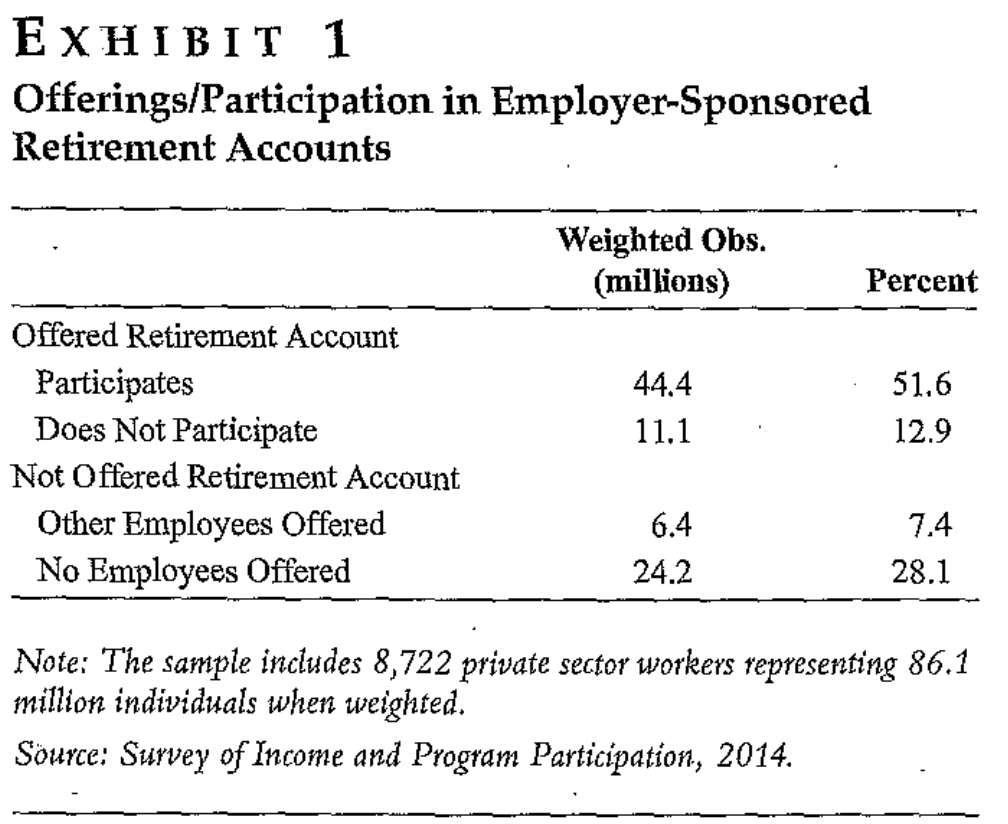
These percentages closely match the percentages for the five states that passed legislation for a state-run Auto-IRA.
Exhibit 2 reports summary statistics for those that would and would not be affected by an Auto-IRA policy. The affected group is less white, less likely to be married, has less education, and has lower income/net worth.
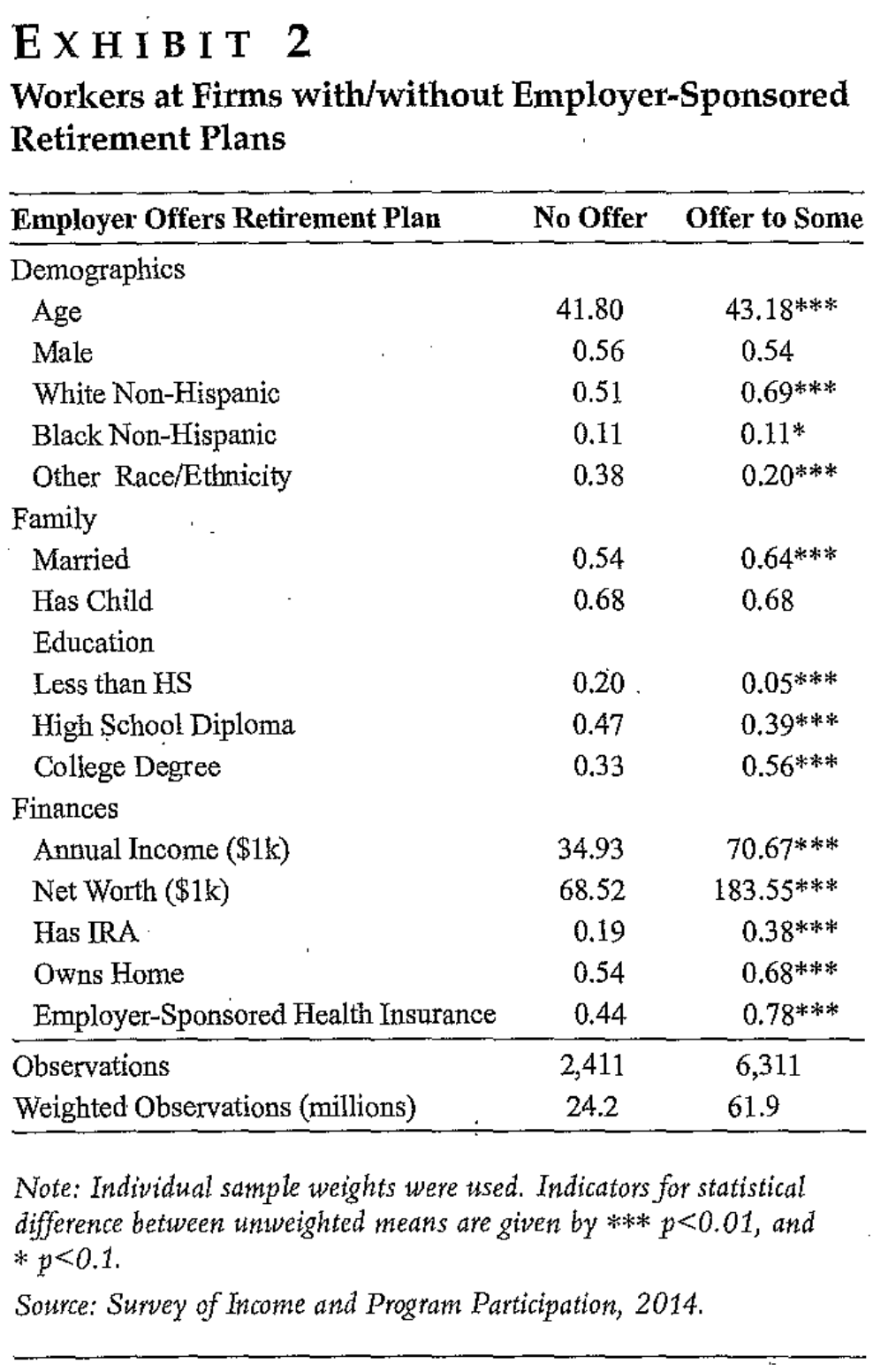
In addition, they are significantly less likely to have employer-sponsored health insurance consistent with less generous fringe benefits. Average annual earnings are $35,000 for affected workers, and 38.5% earn less than $20,000 per year. Given that the first 5% of contributions, up to $1,000, is defaulted into an extremely low-return investment for OregonSaves, the return for many workers will be extremely low.
Almost every employee (96.8%) would have qualified to contribute to a Roth IRA and receive the tax benefits.10 In 2013, 19.2% of affected workers already owned an IRA and 7.5% contributed. Those that contributed to IRAs had significantly higher incomes ($62,415) than those that did not ($32,688). State-run programs typically default employees into Roth accounts rather than traditional IRAs. Roth accounts do not decrease current tax revenue levels, as all contributions are made post-tax.
This benefits current government budgets at the expense of lower tax revenue in the future. In comparison, traditional IRAs collect taxes when the retirement funds are withdrawn during retirement. Of those that contributed independently to an IRA, 25.3% used a Roth account. This low proportion could reflect a preference to immediately defer paying taxes using a traditional IRA. If the low contribution rate and use of Roth accounts were primarily due to lack of financial literacy (Mitchell and Lusardi 2015), then auto-enrollment into Roth rather than traditional IRAs could potentially increase lifetime wealth for these individuals.
To analyze the potential impacts of Auto-IRAs, we use an opt-out rate of 25%, assuming that the actual opt-out rate will be similar to the opt-out rate for the pilot program. Furthermore, we assume that individuals do not decrease savings in other accounts in response to the Auto-IRA program (i.e., no crowd-out, see Poterba, Venti, and Wise 1996). Under these assumptions, IRA savings would increase $24.3 billion from a nationwide Auto-IRA in the first year. As the contribution rate increases due to automatic escalation, this number will increase. This estimate depends greatly on the opt-out rate and the incomes of those that opt-out.
One important factor to consider is individual outstanding debt. From Exhibit 3, 62% have debt with an average balance of $61,395 (driven in large part by mortgages). A significant portion of the sample, 33%, has credit card debt with an average balance of $5,476 (median = $2,500), conditional on having a positive balance. Furthermore, there is significant education and vehicle debt.11
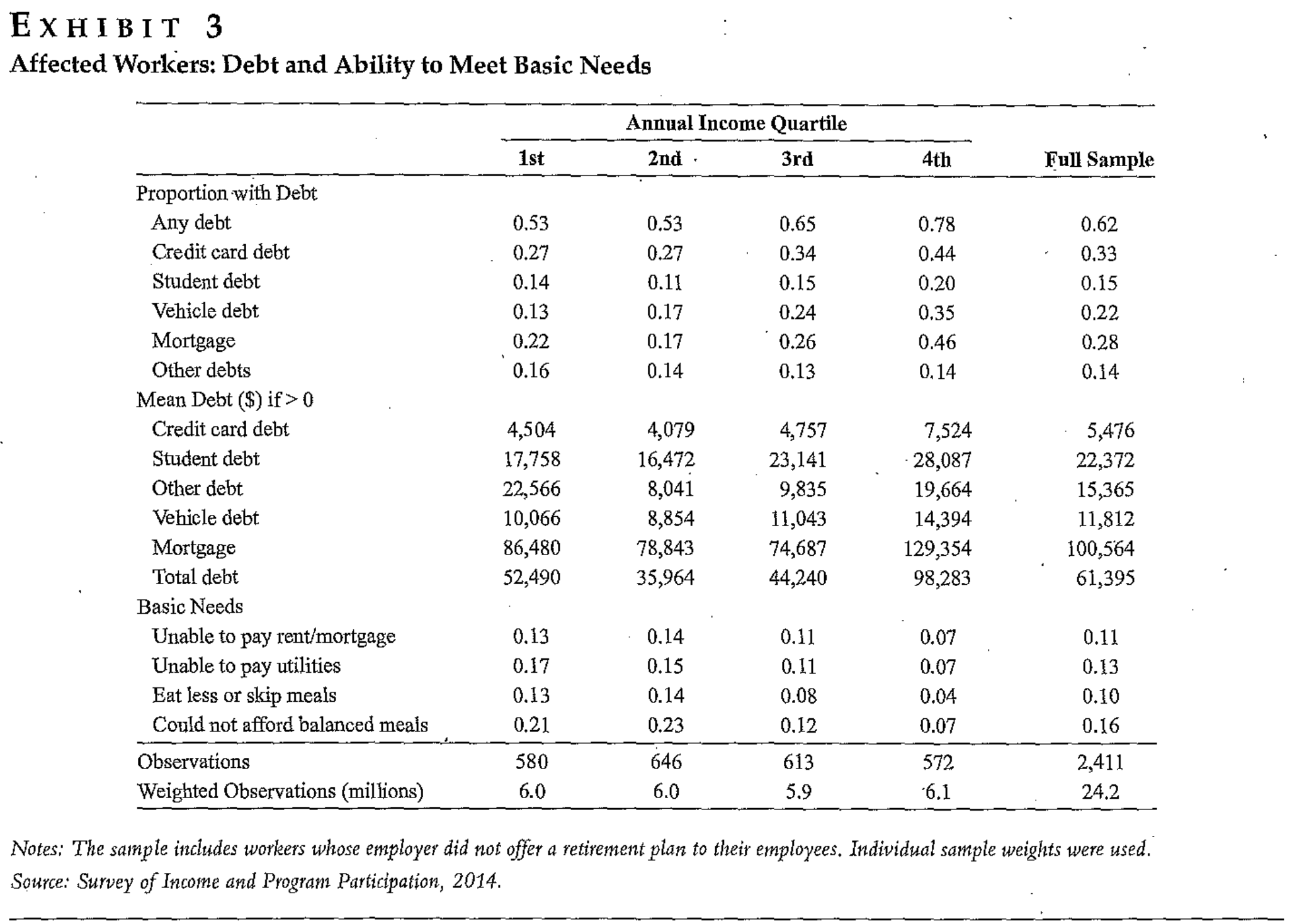
If interest rates on debts exceed the rate of return for a Roth IRA and participants choose not to opt-out, then the Auto-IRA lowers net worth for passive savers with debt. Certainly, credit card interest rates exceed the expected rate of return of investments in Auto-IRAs. In many circumstances, debts from mortgages, student, or automobile loans will also have interest rates that exceed the expected rate of return from the Auto-IRA.
To illustrate, assume that an individual has an annual income of $36,000 and has outstanding credit card debt of $1,800. Further assume that the interest rate on the credit card debt was 13% and the return on a state-run IRA was 0.4% for the first $1,000 defaulted into the Capital Preservation Fund and then 5% for any additional amount defaulted into a target-date fund. If the employee does not opt-out of the Auto-IRA, then she will contribute 5% ($1,800) and earn a return of $44 and have to pay $234 in interest for the credit card debt resulting in a net return of negative $190. If the employee opts out of the Auto-IRA and uses the funds to pay off the credit card debt then the employee does not earn a return on the IRA, but does not have to pay the high-interest payment for the credit card debt (net return of $0). If we assume that the individual already contributed $1,000 to the Capital Preservation Fund such that their entire contribution is made to a target-date fund, then rather than having a return of negative $190, the individual will have a return of negative $144 after taking into account the return from the credit card debt. This example highlights that inasmuch as the interest rate on debt exceeds the expected rate of return of the IRA, then the worker’s optimal strategy is to pay down debt rather than contribute to the retirement account.
Although this concern for individuals with high-interest debt is present for employer-sponsored retirement plans with auto-enrollment, the prevalence of matching contributions counteracts the effects described as any matched contribution effectively results in a 100% rate of return for the employee’s contribution. In contrast to employer-sponsored plans, state-run Auto-IRAs do not allow for matching contributions, resulting in a lower overall rate of return on contributions than employer-sponsored plans on average.
In addition to not reducing outstanding debt as quickly due to retirement contributions, it is also possible that the current debt level could rise. Beshears et al. (2017) show in the context of automatic enrollment in Thrift Savings Plans that borrowing for auto and first-time mortgages increases. Nonetheless, the plan differed greatly from state-run Auto-IRAs in that the Thrift Savings Plans were for U.S. Army civilian employees and the plan featured an employer match.
By design, Auto-IRAs reduce current disposable income. The bottom panel of Exhibit 3 illustrates affected workers’ ability to meet basic expenses with roughly 12% not able to pay rent/mortgage or utilities. Furthermore, 10% were skipping meals or eating less due to financial constraints. If these workers were passive, Auto-IRAs would only exacerbate these problems.12 While the exhibit shows that affected workers with higher incomes are more likely to have debt, lower income individuals are more likely to have difficulty meeting basic needs.
Nationwide Auto-IRAs could affect 24.2 million workers aged 25–64. Many of these workers have high-interest debt or are unable to meet basic needs. Consequently, Auto-IRAs would negatively impact these workers if they do not actively opt-out. Madrian and Shea (2001) found that the lowest income employees were the most likely to increase retirement savings due to auto-enrollment.
These findings are useful to inform policymakers and shed light on changes that could improve retirement savings. An important factor that contributes to the negative effects of the program is an initial default investment with extremely low returns for OregonSaves (first $1,000) and CalSavers (first three years). A default investment of into target-date retirement funds—like in Illinois Secure Choice Saving Program—lessens the negative impacts for passive savers with debt. As early evidence from Oregon notes, average contributions to OregonSaves are very small, meaning the large majority of the investment is in the low-return capital preservation fund. As of February 2018, 94% of all assets invested in OregonSaves were in the Capital Preservation Fund, with 5% in target-date funds and 1% in growth funds (Oregon 2018). Auto-IRA policies that default contributions into higher-returning investments (with a corresponding increase in risk) could lessen the negative impact of auto-enrollment on passive savers with high-interest debt. Nonetheless, regardless of the chosen default, defaults set by a central planner still have the potential to negatively affect workers.
Studies showing benefits of Auto-IRAs such as delayed claiming of Social Security benefits (Pew 2018) assume the contributions go into a life-cycle fund with rates of return of 2.9% for government bonds, 3.4% for corporate bonds, and 6.4% for stocks (and administrative expenses of 0.75% of assets). Other work that forecasts retirement wealth assumes a 5% annual return (Cole 2017). Given the actual magnitude of the contributions in OregonSaves, as well as the investment defaults, the assumptions on annual returns appear to be too optimistic.
The primary concern raised in this study is the detrimental effects of Auto-IRA on individuals that should opt-out but likely will not due to inertia. Nonetheless, policymakers could take active steps to discourage such individuals with high-interest debt from participating in the Auto-IRA. For example, correspondence with employees could highlight the importance of paying off high-interest debt prior to contributing to retirement accounts. However, if advertising campaigns and information provision were adequate to change retirement saving behavior, then why is automatic enrollment necessary to encourage savings in the first place?
As time elapses, the opt-out rates and debt levels of various groups can be assessed empirically. If individuals with high-interest debt actively opted out then the negative effects described would be mitigated whereas if these individuals were less likely to opt-out then the negative effects would be exacerbated. The use of data on payday loans, carried balances, and actual interest rates—before and after the implementation of state-run Auto-IRAs—would allow for a more precise estimate of the consequences of programs like OregonSaves. Furthermore, the observed change in these measures of financial well-being could be compared with the response of individuals in states without Auto-IRA plans to establish a causal relationship between the policy change and financial well-being.
Benartzi, S., and R. H. Thaler. 2013. “Behavioral Economics and the Retirement Savings Crisis.” Science 339 (6124): 1152–1153.
Beshears, J., J. J. Choi, D. Laibson, B. C. Madrian, and W. L. Skimmyhorn. 2017. “Borrowing to Save? The Impact of Automatic Enrollment on Debt.” https://scholar.harvard.edu/files/laibson/files/total_savings_impact_2017_12_06.pdf?m=1513005051.
Biggs, A. G. 2017. “How Hard Should We Push the Poor to Save for Retirement?” Working paper, Available at SSRN: https://ssrn.com/abstract=3001397.
Chetty, R., J. N. Friedman, S. Leth-Petersen, T. H. Nielsen, and T. Olsen. 2014. “Active vs. Passive Decisions and Crowd-Out in Retirement Savings Accounts: Evidence from Denmark.” Quarterly Journal of Economics 129 (3): 1141–1219.
Cole, C. R. 2017. “The Potential Impact of State-Based Retirement Plans on Retirement Savings.” Journal of Financial Service Professionals 71 (5): 68–76.
Engen, E. M., W. G. Gale, and J. K. Scholz. 1996. “The Illusory Effects of Saving Incentives on Saving.” Journal of Economic Perspectives 10 (4): 113–138.
Gale, W., and D. John. 2017. “State Sponsored Retirement Savings Plans: New Approaches to Boost Retirement Plan Coverage.” Pension Research Council Working paper, https://pensionresearchcouncil.wharton.upenn.edu/wp-content/uploads/2017/09/WP-2017-12-John-Gale.pdf.
Hubbard, S. 2018. “State Savings Program Settles.” The Register-Guard, http://www.registerguard.com/rg/news/local/36599134-75/state-sponsored-retirement-plan-oregonsaves-reaches-settlement-with-national-trade-group.html.csp.
Lobosco, K. 2016. “After One Year, 20,000 People Are Saving for Retirement with Obama’s myRA.” CNN Money, http://money.cnn.com/2016/12/16/retirement/obama-myra-retirement-saving/index.html.
Madrian, B. C., and D. F. Shea. 2001. “The Power of Suggestion: Inertia in 401(k) Participation and Savings Behavior.” Quarterly Journal of Economics 116(4): 1149–1187.
Massena, L. A. 2017. “Launching OregonSaves: Early Lessons from an Innovative Public-Private Partnership.” Georgetown University Center for Retirement Initiatives, https://cri.georgetown.edu/launching-oregonsaves-early-lessons-from-an-innovative-public-private-partnership/.
Maxim, R., and M. Muro. 2018. “Rethinking Worker Benefits for an Economy in Flux.” The Brookings Institution, The Avenue, https://www.brookings.edu/blog/the-avenue/2018/03/29/rethinking-worker-benefits-for-an-economy-in-flux/.
Mitchell, O. S., and A. Lusardi. 2015. “Financial Literacy and Economic Outcomes: Evidence and Policy Implications.” The Journal of Retirement 3 (1): 107.
Munnell, A. H., and D. Bleckman. 2014. “Is Pension Coverage a Problem in the Private Sector?” Issue in Brief, 14-7, http://crr.bc.edu/wp-content/uploads/2014/04/IB_14-7-508.pdf.
NAPA. 2018. “Opt-Outs Running High in OregonSaves Program.” https://www.napa-net.org/news/technical-competence/state-auto-ira-plans/opt-outs-running-high-oregonsaves-program/.
O’Brien, S. 2018. “States Could Help Future Retirees Get More Cash from Social Security.” CNBC, https://www.cnbc.com/2018/03/22/state-run-retirement-plans-future-help-retirees-maximize-social-security.html.
Oregon Retirement Savings Board. 2018. “Directors Update for the Oregon Retirement Savings Board.” https://www.oregon.gov/retire/SiteAssets/Pages/Meetings/ORSB%20-%20Exhibit%20Book.pdf.
Pew Charitable Trusts. 2016. “Who’s In, Who’s Out.” http://www.pewtrusts.org/~/media/assets/2016/01/retirement_savings_report_jan16.pdf.
Pew Charitable Trusts. 2018. “Auto-IRAs Could Help Retirees Boost Social Security Payments.” http://www.pewtrusts.org/~/media/assets/2018/03/auto_ira_accounts_and_social_security_brief.pdf.
Poterba, J. M., S. F. Venti, and D. A. Wise. 1996. “How Retirement Saving Programs Increase Saving.” Journal of Economic Perspectives 10 (4): 91–112.
Thaler, R. H., and S. Benartzi. 2004. “Save More TomorrowTM: Using Behavioral Economics to Increase Employee Saving.” Journal of Political Economy 112 (S1): S164–S187.
Thaler, R. H., and C. R. Sunstein. 2008. Nudge: Improving Decisions about Health, Wealth, and Happiness. New Haven: Yale University Press.
To order reprints of this article, please contact David Rowe at d.rowe@pageantmedia.com or 646-891-2157.
1. The OregonSaves pilot program had an opt-out rate of 23%. See https://www.wsj.com/articles/states-test-workplace-retirement-plans-for-residents-lacking-them-1502881230. A similar plan implemented in the United Kingdom has an opt-out rate of roughly 10%. See https://www.nestpensions.org.uk/schemeweb/NestWeb/includes/public/docs/nest-insight-2015.pdf.
2. See https://www.federalreserve.gov/releases/g19/current/default.htm and https://studentaid.ed.gov/sa/sites/default/files/aid-glance-2017-18.pdf for more information.
3. Arizona, Colorado, Indiana, Kentucky, Louisiana, Maine, and Michigan have all introduced legislation that would establish state-run Auto-IRAs. See https://www.aarp.org/ppi/state-retirement-plans/savings-plans/ for more details.
4. Government-run Auto-IRAs have been implemented in the United Kingdom and New Zealand. See Biggs (2017) for a summary of the main findings.
5. A previous government retirement plan sponsored by the Treasury Department in 2015 for workers without access to employer-sponsored retirement plans, myRA, did not incorporate mandatory employer participation or auto-enrollment. Consequently, the program had very low participation levels (Lobosco, 2016) and was discontinued in 2017.
6. See https://saver.oregonsaves.com/oregoneetpl/fund/viewPricePerformance.cs for a fund performance summary of OregonSaves.
7. See http://illinoistreasurer.gov/TWOCMS/media/doc/SecureChoiceFlyer.20171006.pdf and http://www.treasurer.ca.gov/scib/employees.asp respectively for more information on plans for Illinois and California.
8. This is lower than the 42% derived from the Current Population Survey (Pew 2016), but nearly identical to the 26% derived from the National Compensation Survey for adults aged 25–64 (Munnell and Bleckman 2014).
9. We classify workers as being offered a plan if the employer offered a plan to at least some employees and the respondent’s reason for not participating did not include one of the following: job type not allowed, does not work enough, has not been employed long enough, started job too close to retirement date, or is too young.
10. Individuals are eligible if they have taxable earnings and earn less than $118,000 if filing as a single individual or $186,000 if married filing jointly. The statistic assumes that the employees file as single individuals. See https://www.irs.gov/retirement-plans/amount-of-roth-ira-contributions-that-you-can-make-for-2017.
11. For the five states that passed legislation, the proportion of the sample with debt is slightly lower with 55.3% having debt and 30.7% with credit card debt.
12. Individuals may take out distributions up to amount initially contributed without facing any tax penalty. Nonetheless, 36% of workers had both outstanding credit card debt and positive Roth IRA balances, which is suggestive of a misunderstanding regarding Roth IRA withdrawals.
End of article. Read the PDF