# Pricing Anomalies in the Market for Diamonds: Evidence of Conformist Behavior

Frank Scott and Aaron Yelowitz. “Pricing Anomalies in the Market for Diamonds: Evidence of Conformist Behavior.” Economic Inquiry 48(2) (2010): 353–368. https://doi.org/10.1111/j.1465-7295.2009.00237.x

<p class="source-format-note">Complete article reading edition. Tables and figures reproduce the published source; open an image for full resolution. The PDF retains the original page layout.</p>

**Affiliations:** Frank Scott and Aaron Yelowitz — Department of Economics, University of Kentucky.  

## Abstract

Some goods are consumed not just for their intrinsic utility but also for the impression their consumption has on others. We analyze the market for such a commodity—diamonds. We collect data on price and other attributes from the inventories of three large online retailers of diamonds. We find that people are willing to pay premiums upward of 18% for a diamond that is one-half carat rather than slightly less than a half carat and between 5% and 10% for a one-carat rather than a slightly less than one-carat stone. Since a major portion of larger gem-quality diamonds are used for engagement rings, such an outcome is consistent with Bernheim’s model of conformism, where individuals try to conform to a single standard of behavior that is often established at a focal point. In this case, prospective grooms signal their desirability as a mate by the size of the diamond engagement ring they give their fiancées.

**JEL classification:** A1; D4

## I. INTRODUCTION

Diamonds have long intrigued economists. Adam Smith and the classical economists asked why diamonds, which have so little value in use, have such high value in exchange. It took another century before Jevons and the marginalists offered a satisfactory resolution.<sup id="printed-note-ref-1"><a href="#printed-note-1" role="doc-noteref" aria-label="Note 1">1</a></sup> Diamonds are not the typical economic good. In industrial processes requiring drilling or grinding, their hardness makes them a valuable input. But, in their other primary use, jewelry, consumption decisions have two dimensions.

Consumers demand diamonds for the intrinsic utility that comes from wearing pretty things. As Becker, Murphy, and Werning (2005) point out, however, “a subset of goods, such as diamonds and gold, may implicitly provide a market for social status, perhaps by the relative amounts consumed of these goods.” Ng (1987) introduces the term “diamond effect” to refer to goods like diamonds that are valued not for their intrinsic consumption effects but because they are costly. Bagwell and Bernheim (1996) suggest that because expensive jewelry is readily observable, it provides a “durable emblem of substantial resource dissipation.” Glazer and Konrad (1996) offer diamond rings as a prime example of conspicuous consumption intended as a signal of status.

**Author note:** We would like to thank the referee and numerous colleagues for helpful suggestions on earlier drafts of this article. Our data are available at http://gatton.uky.edu/faculty/yelowitz/diamonds/.  

**Scott:** Gatton Professor, Department of Economics, University of Kentucky, Lexington, KY 40506-0034. Phone 1-859-257-7643, E-mail fscott@uky.edu  

**Yelowitz:** Associate Professor, Department of Economics, University of Kentucky, Lexington, KY 40506-0034. Phone 1-859-257-7634, E-mail aaron@uky.edu

There are several aspects of the market for gem-quality diamonds that make it interesting to study. First, nature introduces exogeneity on the supply side that determines the characteristics of diamonds offered for sale. Second, while diamonds rank high on the visibility scale,<sup id="printed-note-ref-2"><a href="#printed-note-2" role="doc-noteref" aria-label="Note 2">2</a></sup> the exact attributes of a diamond ring are only imperfectly observable to other people, and so to a certain degree, they must rely on information provided by the ring’s owner. Third, a primary source of the demand for diamonds is for engagement rings. In the early days of the industry, Cecil Rhodes connected the number of diamonds supplied annually to European consumers by De Beers to the number of wedding engagements.<sup id="printed-note-ref-3"><a href="#printed-note-3" role="doc-noteref" aria-label="Note 3">3</a></sup> As a result, diamonds purchased for engagement rings represent in some sense the posting of a bond in the formation of a long-term relationship.<sup id="printed-note-ref-4"><a href="#printed-note-4" role="doc-noteref" aria-label="Note 4">4</a></sup> While customers have traditionally purchased diamonds by visiting jewelry stores and other bricks-and-mortar locations, a thriving online market for diamonds has recently developed. Online sellers like Blue Nile, Union, and Amazon sell individual diamonds as well as diamond jewelry. Each has tens of thousands of diamonds in inventory, which they offer for sale on their Web sites. We have collected data from each of these diamond retailers and use these data to analyze empirically the determinants of diamond prices. We find significant jumps in prices at round number sizes or “focal points.” For example, we find that buyers are willing to pay premiums upward of 18% for a diamond that is one-half carat rather than slightly smaller than one-half carat and between 5% and 10% for a one-carat diamond rather than a slightly less than one-carat diamond.

### ABBREVIATIONS

GIA: Gemological Institute of America  

**Publication metadata:** doi:10.1111/j.1465-7295.2009.00237.x; Online Early publication October 12, 2009; © 2009 Western Economic Association International

Such an anomalous market outcome for a good that already has been singled out by economists as being different begs closer scrutiny. In the next section of the article, we explore in more detail the market for diamonds and describe the data that we have collected from online diamond retailers. Following that, we analyze empirically the various attributes of diamonds that determine their prices, which allows us to identify pricing discontinuities that occur at focal point sizes. We then explore several alternative explanations for the observed pricing anomalies, including whole-number effects, rule-of-thumb purchasing decision rules, diamonds as a store of value, and status good/posting bond reasons. We conclude that the diamond market exemplifies conformist behavior, wherein prospective grooms influence their fiancée’s perception of them as a marital prospect through the size of the engagement ring they purchase.

## II. THE MARKET FOR DIAMONDS

### A. Supply

On the supply side of the market, the vertical supply chain for diamonds is characterized by tight cartel upstream and competition downstream.<sup id="printed-note-ref-5"><a href="#printed-note-5" role="doc-noteref" aria-label="Note 5">5</a></sup> The majority of the world’s rough diamonds are marketed by De Beers, but cutting and polishing rough stones and marketing the finished jewels are a highly competitive business.<sup id="printed-note-ref-6"><a href="#printed-note-6" role="doc-noteref" aria-label="Note 6">6</a></sup> Since it is the interaction of consumers with downstream suppliers of finished jewels that we are interested in, we need to understand the production decisions of diamond cutters.

Rough diamonds are the product of nature, which introduces considerable exogeneity into the supply process, especially among larger stones. When diamond processors purchase raw stones, their challenge is to determine the optimal configuration of finished jewels that can be obtained from the rough stone. “Calculating the shape and size of polished gems that can be carved from a rough stone without losing too much material is the true art in cutting and polishing.”<sup id="printed-note-ref-7"><a href="#printed-note-7" role="doc-noteref" aria-label="Note 7">7</a></sup> The profit-maximizing configuration will depend on consumer demand for finished jewels.

There is general industry agreement about the characteristics that determine the market value of a finished jewel—the four C’s.<sup id="printed-note-ref-8"><a href="#printed-note-8" role="doc-noteref" aria-label="Note 8">8</a></sup> According to sellers, the value of a diamond depends on color, carat, cut, and clarity. Colorless and near-colorless diamonds have greater brilliance. The weight or size of a diamond is measured in carats. The cut of a diamond has a significant effect on its sparkle or brilliance.<sup id="printed-note-ref-9"><a href="#printed-note-9" role="doc-noteref" aria-label="Note 9">9</a></sup> Diamonds that are completely free from internal flaws or inclusions are very rare.

Color and clarity are predetermined by nature, but within the limits imposed by the rough stone, the particular shape as well as the carat weight and cut are determined in the production process. A diamond processor can cut a rough stone into one or more finished jewels and so will choose the shape, size, and cut of a diamond to maximize profits. Consumer preferences for size, shape, and cut thus will drive the production decisions of diamond processors. Competition will push producers to trade off between size and cut, for example, according to consumers’ marginal rate of substitution between size and cut. Producers will alter the depth of cut in a way that reduces the carat weight of a finished stone as long as consumers notice the increased brilliance and are willing to pay more for the slightly smaller but more ideally cut stone. Finally, holding other attributes constant, if consumers’ willingness to pay is a continuous function of the size of the diamond, then we would expect to see a continuum of diamonds, declining in carat weight, supplied in the market.

### B. Demand

Consumer demand for diamonds used in jewelry is complex. Cubic zirconium and synthetic diamonds, to the casual observer, are very close substitutes for natural diamonds in terms of appearance and glitter.<sup id="printed-note-ref-10"><a href="#printed-note-10" role="doc-noteref" aria-label="Note 10">10</a></sup> A one-carat cubic zirconium stone costs $10, and a one-carat laboratory-made diamond may cost several thousand dollars. Depending on quality and cut, however, a one-carat natural diamond may cost $6,000 or more. That consumers are willing to pay so much extra for a “real” diamond supports Becker, Murphy, and Werning’s (2005) suggestion that there is a status element to the demand for diamonds and Ng’s (1987) assertion that it is the value of the diamond, and not the diamond itself, that matters.

This element of the appeal of diamonds to consumers is not new to economists (including, for example, Adam Smith), but the management of demand through sophisticated marketing is relatively recent. De Beers introduced its well-known slogan “A diamond is forever” in 1948, part of its ongoing campaign to equate diamonds with love.<sup id="printed-note-ref-11"><a href="#printed-note-11" role="doc-noteref" aria-label="Note 11">11</a></sup> European jewelers Cartier, De Beers/Louis Vuitton, and Bulgari have entered the high-end engagement ring business to compete in a market segment previously dominated by Tiffany’s.<sup id="printed-note-ref-12"><a href="#printed-note-12" role="doc-noteref" aria-label="Note 12">12</a></sup> And De Beers has also recently targeted older married couples with three-stone anniversary rings for “past, present, and future” and women of independent means with right-hand rings.<sup id="printed-note-ref-13"><a href="#printed-note-13" role="doc-noteref" aria-label="Note 13">13</a></sup>

### C. The Online Market

There is a very active online market for diamonds and diamond jewelry. As a result of clearly defined product attributes and the possibility of independent certification, diamonds are well suited for sale by electronic commerce vendors. Three of the largest online retailers are Blue Nile, Union, and Amazon. Blue Nile is the largest and probably the best known online diamond merchant and at any time has an inventory of tens of thousands of diamonds. Union is another large online diamond seller, with an inventory almost as big as that of Blue Nile’s. Amazon has recently added diamonds to its extensive product line, but its inventory is less than half that of Blue Nile or Union. These merchants offer diamonds for sale over the Internet and post the price for each diamond on their Web sites along with the other pertinent characteristics of the diamond. Diamonds are graded by independent laboratories according to cut, color, clarity, carat weight, and polish and symmetry.<sup id="printed-note-ref-14"><a href="#printed-note-14" role="doc-noteref" aria-label="Note 14">14</a></sup>

Carat weight is obviously an important determinant of the price of a diamond, but color, cut, and clarity are also important. The color in a diamond affects the spectrum of the color of the light emitted by a diamond. Less color is desired, and colorless is most desired. Color is graded on a letter scale, with grade D signifying absolutely colorless. Blue Nile carries colorless and near-colorless diamonds, including grades D, E, F, G, H, I, and J. Union carries grades D through M, and Amazon carries grades D through J. Many diamonds have inclusions, which are scratches, trace minerals, or other imperfections that impact the clarity of the diamond. The number, location, size, and type of inclusions determine the grade for clarity that is given to the diamond. Diamonds in Blue Nile’s, Union’s, and Amazon’s inventories are graded as flawless (FL, IF), very very slightly included (VVS1, VVS2), very slightly included (VS1, VS2), and slightly included (SI1, SI2). Cut refers to the roundness, depth and width, and uniformity of the facets, all of which affect the brilliance of the diamond. The grades of cut carried in Blue Nile’s and Amazon’s inventories are ideal, very good, good, and fair.

Diamond merchants, online and otherwise, go to great lengths to educate consumers about the 4 C’s and other aspects of diamonds. They also have user-friendly Web sites that guide consumers in the search process. At Blue Nile, for example, a consumer who wants to search for an individual diamond is prompted first to choose a shape and then to suggest (not required) a price range. The next prompt displays sliding scales for carat, cut, color, clarity, and price so that the consumer can further narrow the search parameters. All the diamonds in Blue Nile’s inventory conforming to the selected search parameters are then displayed to the consumer in ascending order of price. Independent laboratory reports on each diamond are accessible to the consumer at this point as well.

## III. DATA

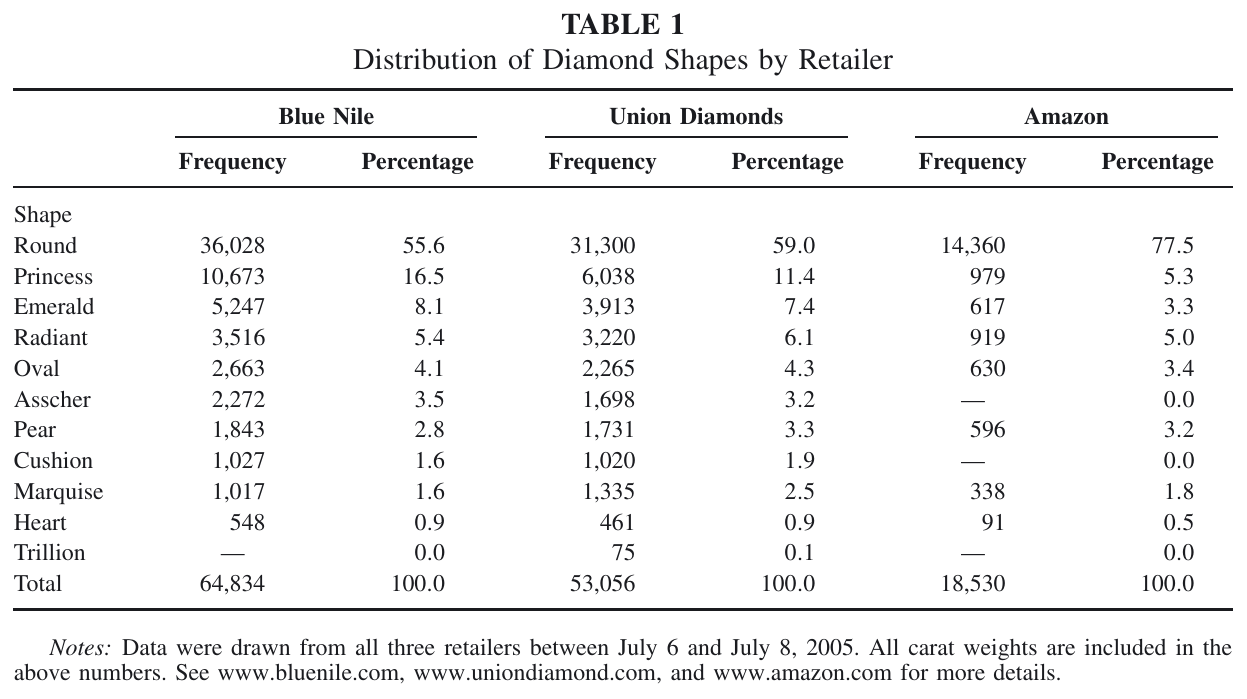
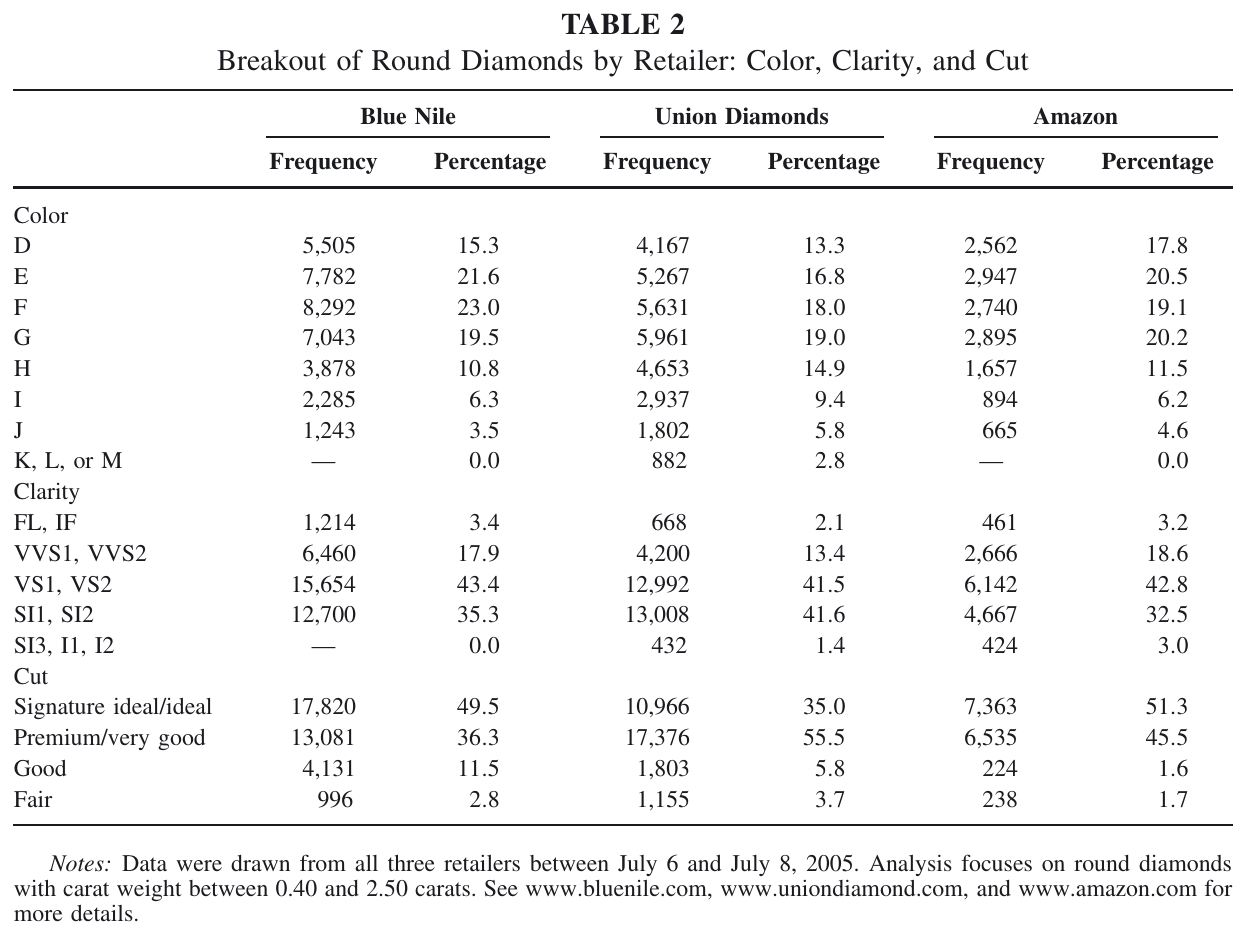
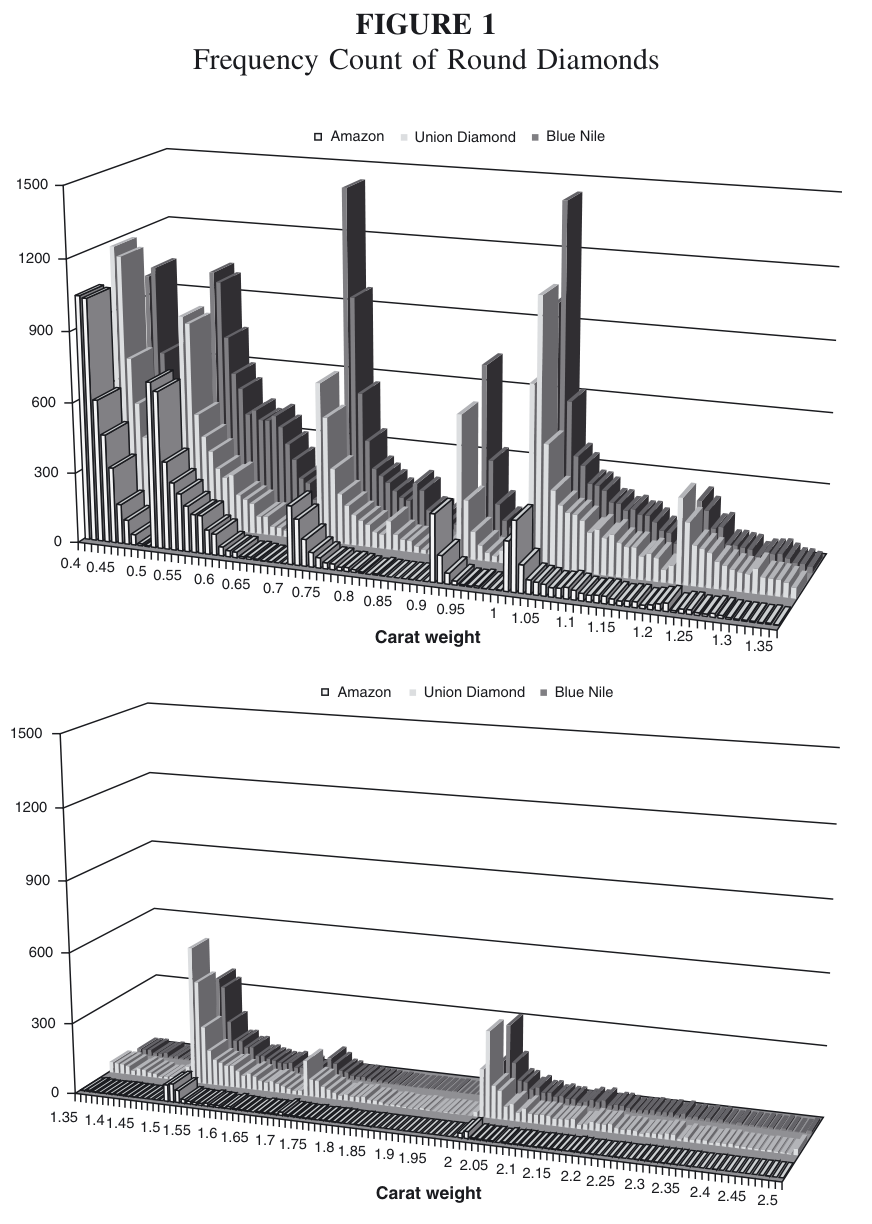
We manually gathered data for every diamond listed on each of the three merchants’ Web sites from July 6 to July 8, 2005.<sup id="printed-note-ref-15"><a href="#printed-note-15" role="doc-noteref" aria-label="Note 15">15</a></sup> On that date, Blue Nile had 64,834 diamonds in its online inventory. There were 53,056 diamonds in Union’s online inventory. Amazon had 18,530 diamonds in its inventory. We sorted the diamonds by shape since buyers apparently are lexicographic—first picking their preferred shape and then comparing diamonds according to cut, clarity, color, and carat size. Round diamonds are by far the most popular shape, followed by princess, emerald, radiant, oval, pear, asscher, marquise, and heart.<sup id="printed-note-ref-16"><a href="#printed-note-16" role="doc-noteref" aria-label="Note 16">16</a></sup> Table 1 lists the number of diamonds by shape in each of the three retailers’ inventories. Table 2 contains frequency distributions of color, cut, and clarity for round diamonds for each of the three companies. We restrict our sample at the low and high ends of the size spectrum and focus on diamonds weighing between 0.4 and 2.5 carats. This restriction reduces the sample sizes to 55,478 for Blue Nile, 45,351 for Union, and 14,034 for Amazon. After sorting by shape, we sorted diamonds by size. Figure 1 contains histograms for round diamonds between 0.4 and 2.5 carats in Blue Nile’s, Union’s, and Amazon’s inventories.

As Figure 1 illustrates, there are considerably fewer diamonds available for sale on the low side of focal point carat weights than on the high side. Among Blue Nile’s round diamonds, there are only 47 diamonds weighing 0.49 carats, while there are 1,030 weighing 0.50 carats. There are 14 diamonds weighing 0.99 carats and 1,022 weighing 1.00 carats. There are two diamonds weighing 1.49 carats, while 379 weigh 1.50 carats. There is one diamond weighing 1.99 carats, while 158 weigh 2.00 carats. Among round diamonds, there also seem to be minor focal points at 0.70, 0.90, 1.20, and 1.70 carats. Since there are 29,947 round diamonds in the size-truncated Blue Nile sample, these asymmetries are readily apparent.

If size were completely exogenously determined by nature, then we would expect to see a smoothly declining continuum of diamonds by carat weight in Figure 1.<sup id="printed-note-ref-17"><a href="#printed-note-17" role="doc-noteref" aria-label="Note 17">17</a></sup> The effect of human intervention, however, is starkly evident from the frequency distributions of carat weights for each online retailer. In fact, the disparities suggest that a 1.49-carat diamond, for example, should be regarded as something of a mistake.<sup id="printed-note-ref-18"><a href="#printed-note-18" role="doc-noteref" aria-label="Note 18">18</a></sup> The relative scarcity of diamonds slightly less than one carat compared to those one carat or larger would ordinarily lead one to expect a slight relative premium for 0.99-carat diamonds after controlling for the underlying positive relationship between size and value. To see whether that is so requires a more complete analysis of the relationship between the price of a diamond and its attributes.

### Table 1. Distribution of Diamond Shapes by Retailer

<figure><a href="/files/publications/ay-ja-t35tuokg5odv5gob-assets/object-01-page-05.png"><img alt="Table 1. Distribution of diamond shapes at Blue Nile, Union Diamonds, and Amazon in July 2005. Round diamonds account for 55.6%, 59.0%, and 77.5% of each retailer's inventory; frequencies and percentages for eleven shapes and totals are shown." height="699" loading="lazy" src="/files/publications/ay-ja-t35tuokg5odv5gob-assets/object-01-page-05.png" width="1247"/></a><figcaption>Table 1. Distribution of Diamond Shapes by Retailer — source page 5. <a href="/files/publications/ay-ja-t35tuokg5odv5gob-assets/object-01-page-05.png">Open full-resolution image</a> · <a href="/files/publications/ay-ja-t35tuokg5odv5gob.pdf#page=5">Read source PDF page</a></figcaption></figure>

**Notes:** Data were drawn from all three retailers between July 6 and July 8, 2005. All carat weights are included in the above numbers. See www.bluenile.com, www.uniondiamond.com, and www.amazon.com for more details.

### Table 2. Breakout of Round Diamonds by Retailer: Color, Clarity, and Cut

<figure><a href="/files/publications/ay-ja-t35tuokg5odv5gob-assets/object-02-page-05.png"><img alt="Table 2. Color, clarity, and cut of round diamonds, 0.40–2.50 carats, at Blue Nile, Union Diamonds, and Amazon. Counts and percentages are grouped by color D through K/L/M, clarity, and four cut grades; source notes describe July 2005 collection." height="936" loading="lazy" src="/files/publications/ay-ja-t35tuokg5odv5gob-assets/object-02-page-05.png" width="1247"/></a><figcaption>Table 2. Breakout of Round Diamonds by Retailer: Color, Clarity, and Cut — source page 5. <a href="/files/publications/ay-ja-t35tuokg5odv5gob-assets/object-02-page-05.png">Open full-resolution image</a> · <a href="/files/publications/ay-ja-t35tuokg5odv5gob.pdf#page=5">Read source PDF page</a></figcaption></figure>

**Notes:** Data were drawn from all three retailers between July 6 and July 8, 2005. Analysis focuses on round diamonds with carat weight between 0.40 and 2.50 carats. See www.bluenile.com, www.uniondiamond.com, and www.amazon.com for more details.

## IV. EMPIRICAL ANALYSIS

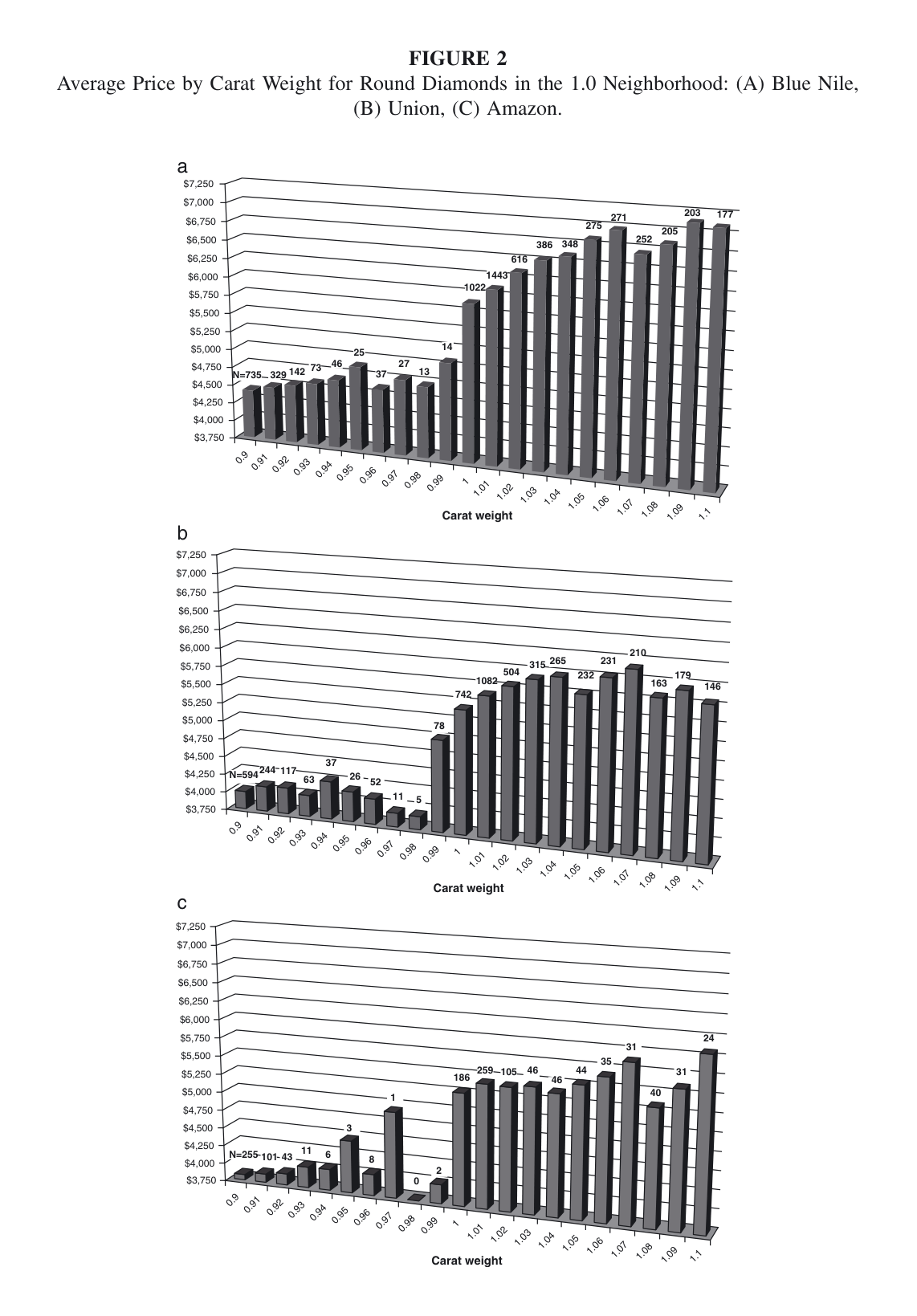
As Figure 1 clearly illustrates, there are distinct discontinuities in the frequency distributions of diamonds by size, which suggests that diamond suppliers are responding to demand signals that consumers are sending. Since there is competition on both buyer and seller sides of the market, equilibrium price differences around focal point cutoffs should reflect producers’ marginal cost of altering cut and shape in order to increase size as well as consumers’ willingness to pay for a slightly larger diamond. We start our investigation by comparing prices of diamonds above and below half- and whole-carat focal points. Figure 2 illustrates the average price of round diamonds weighing between 0.9 and 1.1 carats for Blue Nile, Union, and Amazon. The number of diamonds in each size category is indicated as well, which makes clear the paucity of stones on the low side of focal point sizes. As can be seen, price is generally increasing in carat weight, but there appears to be a distinct jump in the relationship at 1.0 carats.<sup id="printed-note-ref-19"><a href="#printed-note-19" role="doc-noteref" aria-label="Note 19">19</a></sup> Similar breaks occur in the relationship between price and carat weight at other focal points for all three online merchants.

### Figure 1. Frequency Count of Round Diamonds

<figure><a href="/files/publications/ay-ja-t35tuokg5odv5gob-assets/object-03-page-06.png"><img alt="Figure 1. Frequency counts of round diamonds by carat weight at Amazon, Union Diamond, and Blue Nile. Two panels cover 0.40–1.35 and 1.35–2.50 carats and show concentrations near half- and whole-carat focal points." height="1224" loading="lazy" src="/files/publications/ay-ja-t35tuokg5odv5gob-assets/object-03-page-06.png" width="872"/></a><figcaption>Figure 1. Frequency Count of Round Diamonds — source page 6. <a href="/files/publications/ay-ja-t35tuokg5odv5gob-assets/object-03-page-06.png">Open full-resolution image</a> · <a href="/files/publications/ay-ja-t35tuokg5odv5gob.pdf#page=6">Read source PDF page</a></figcaption></figure>

**Caption:** Frequency Count of Round Diamonds.

### Figure 2. Average Price by Carat Weight for Round Diamonds in the 1.0 Neighborhood: (A) Blue Nile, (B) Union, (C) Amazon

<figure><a href="/files/publications/ay-ja-t35tuokg5odv5gob-assets/object-04-page-07.png"><img alt="Figure 2. Average prices and inventory counts for round diamonds from 0.90 to 1.10 carats. Panels A, B, and C show Blue Nile, Union Diamond, and Amazon, with an upward price discontinuity at one carat." height="1639" loading="lazy" src="/files/publications/ay-ja-t35tuokg5odv5gob-assets/object-04-page-07.png" width="1142"/></a><figcaption>Figure 2. Average Price by Carat Weight for Round Diamonds in the 1.0 Neighborhood: (A) Blue Nile, (B) Union, (C) Amazon — source page 7. <a href="/files/publications/ay-ja-t35tuokg5odv5gob-assets/object-04-page-07.png">Open full-resolution image</a> · <a href="/files/publications/ay-ja-t35tuokg5odv5gob.pdf#page=7">Read source PDF page</a></figcaption></figure>

**Caption:** Average Price by Carat Weight for Round Diamonds in the 1.0 Neighborhood: (A) Blue Nile, (B) Union, (C) Amazon.

While a simple comparison of prices below and above focal point sizes is informative, it is obviously incomplete. For example, among the 1,030 round diamonds in Blue Nile’s inventory weighing exactly one-half carat, prices varied considerably, ranging from $948 to $3,857. Since shape, cut, color, and clarity also influence market price, we must control for the effects of these other attributes.<sup id="printed-note-ref-20"><a href="#printed-note-20" role="doc-noteref" aria-label="Note 20">20</a></sup> Also, there is a well-known nonlinearity in the relationship between diamond size and price. Because half-carat diamonds and two-carat diamonds may attract entirely different types of buyers and may constitute separate product markets, we localize our regressions by including sizes just below and just above each focal point.

Our first specification regresses log price on carat weight, color, cut, and clarity. To allow the relationship between log price and carat weight to be nonlinear, we include linear and quadratic term for carat weight. We report the results from ordinary least squares (OLS) regressions, which correct standard errors for heteroskedasticity. Omitted dummy variable categories are “diamond color is D, E, or F,” “clarity is flawless or internally flawless,” and cut is “ideal or signature ideal.”

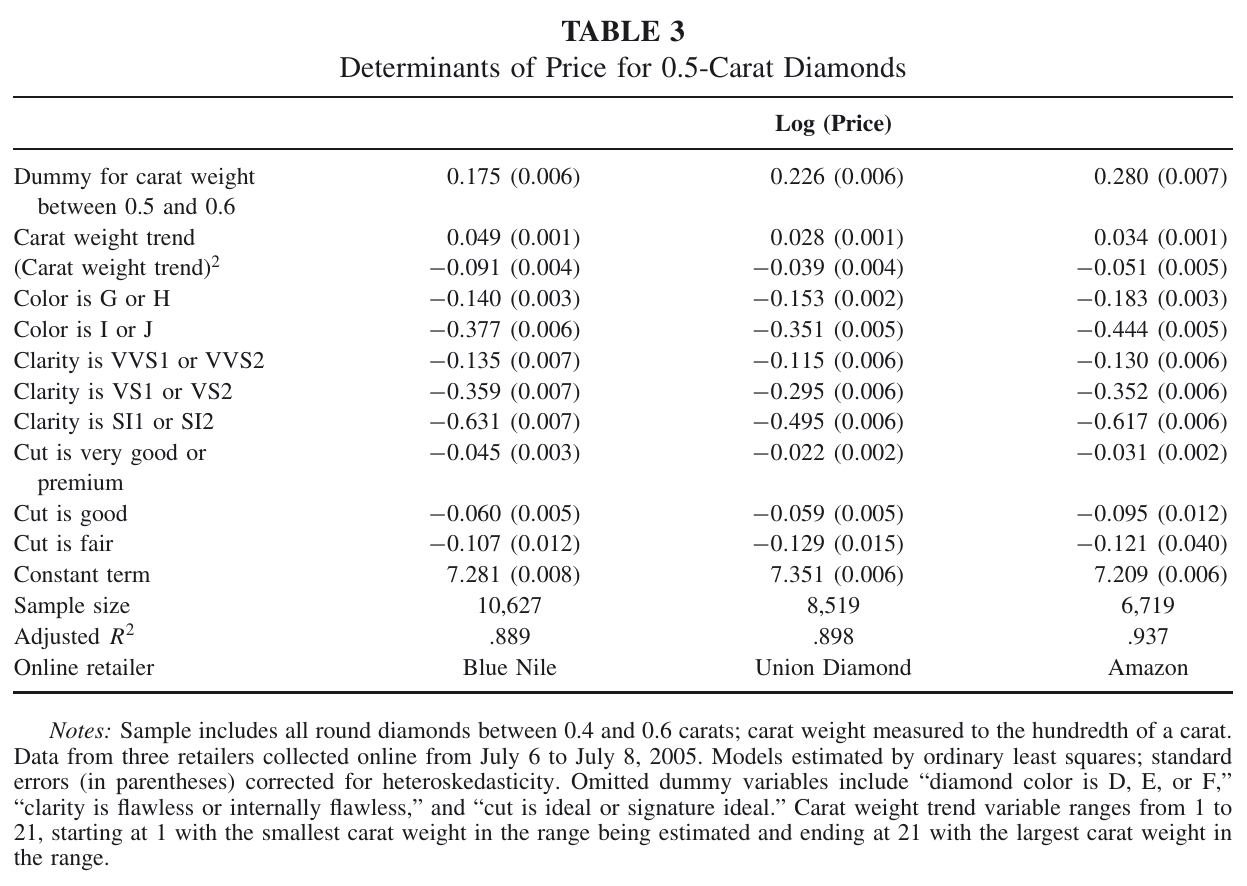
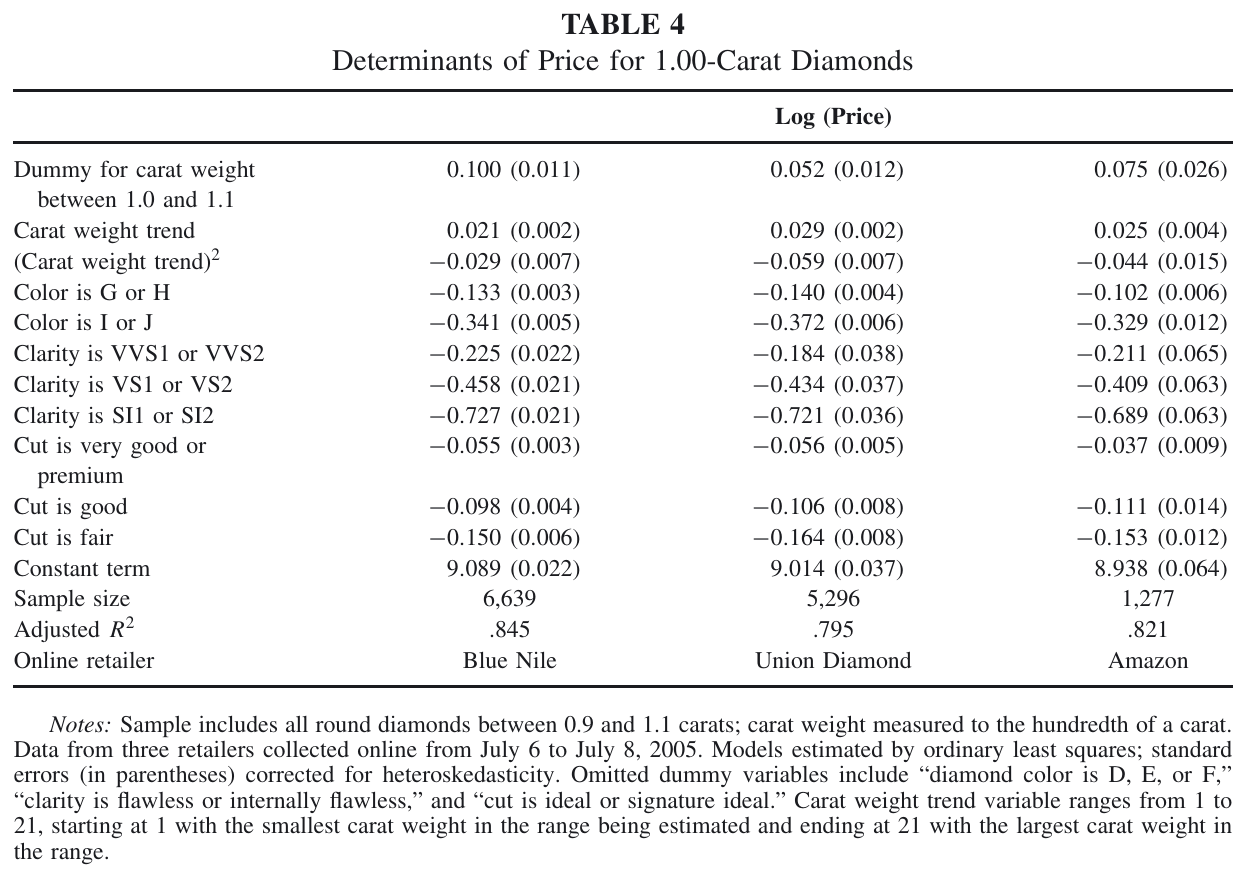
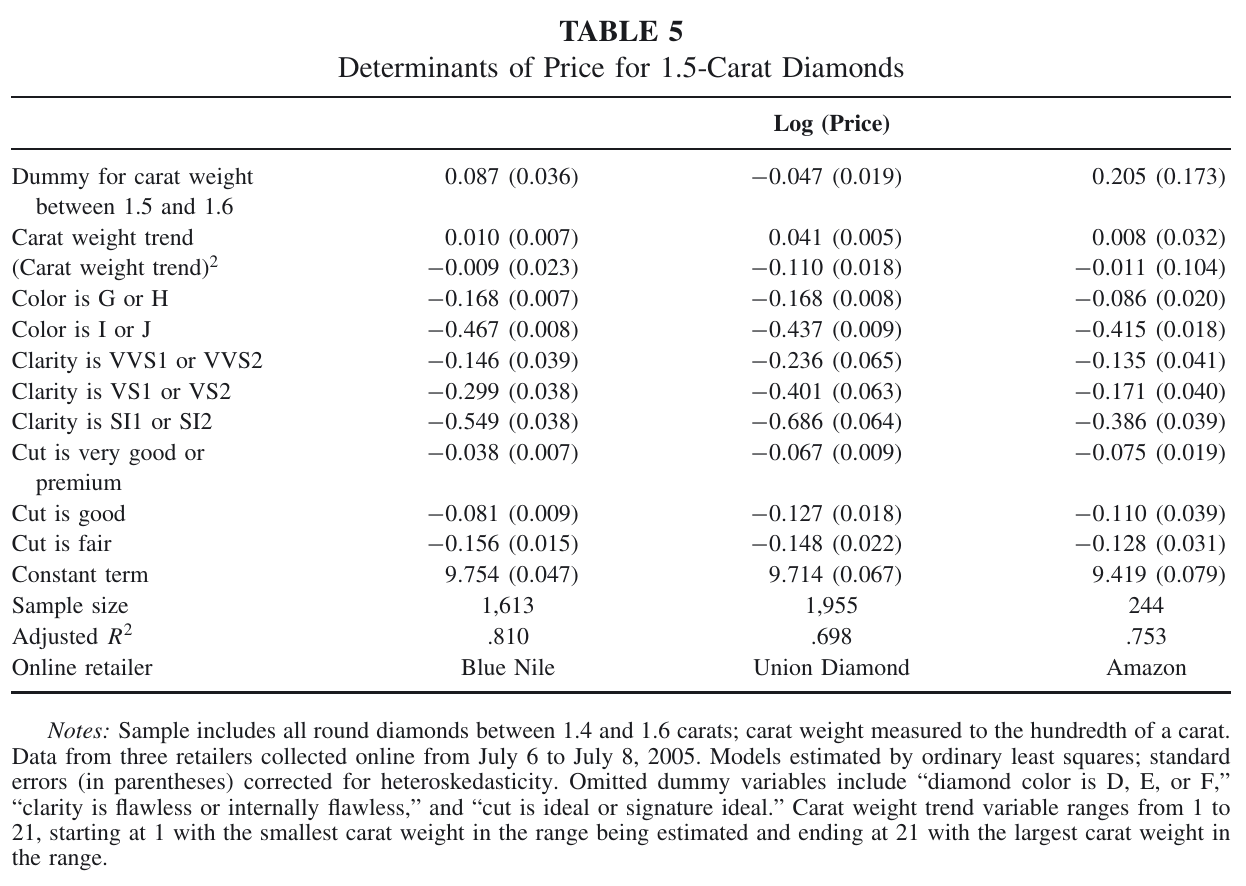
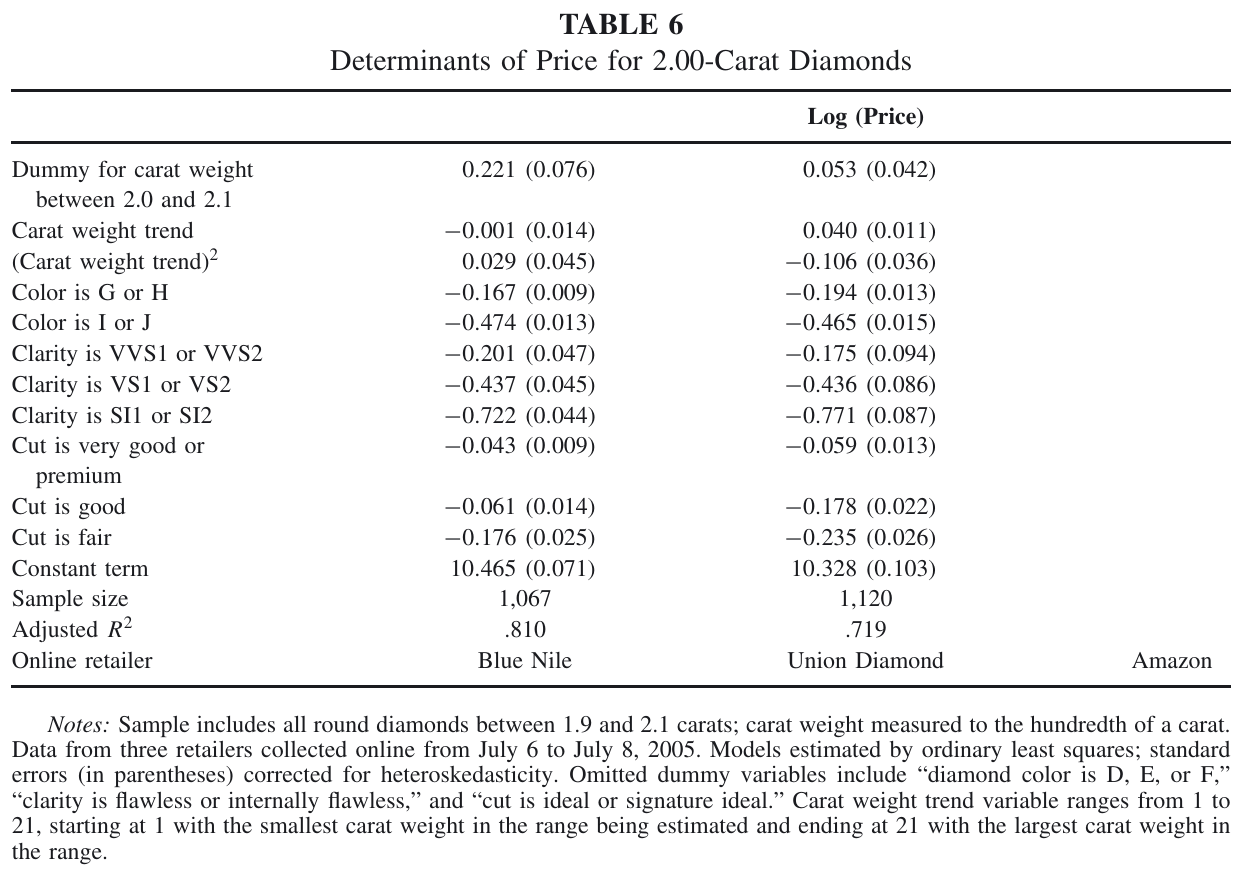
Tables 3–6 include results for round diamonds between 0.40 and 0.60 carats, 0.90 and 1.10 carats, 1.40 and 1.60 carats, and 1.90 and 2.10 carats.<sup id="printed-note-ref-21"><a href="#printed-note-21" role="doc-noteref" aria-label="Note 21">21</a></sup> We include a carat weight trend variable and its square along with a dummy variable to indicate whether the size of the diamond is greater than or equal to the focal point carat weight.<sup id="printed-note-ref-22"><a href="#printed-note-22" role="doc-noteref" aria-label="Note 22">22</a></sup> The carat weight trend should capture the additional intrinsic utility that consumers receive from having a slightly bigger diamond. Any discontinuities in that trend around a focal point should identify whether the disparities in the number of diamonds just below and at or above the focal point lead to a price penalty or price premium. After controlling for other attributes of diamonds and for carat weight trend, there are very noticeable differences in prices surrounding the focal point sizes. For example, in Blue Nile’s inventory, diamonds on the high side of one-half carat are worth 17.5% more than those weighing less than one-half carat after controlling for color, cut, clarity, and the nonlinear trend in size. In Union’s inventory, the price differential is 22.6%, and in Amazon’s inventory, the differential is 28.0%. All these estimated coefficients are highly significant.

The price difference around 1.00 carats is also significant. In Blue Nile’s inventory, diamonds one carat or larger are priced 10.0% higher than diamonds slightly less than one carat in weight. For Union and Amazon, the differentials are 5.2% and 7.5%, respectively. Around the focal points of 1.50 and 2.00 carats, the results are not as precisely estimated due to the paucity of diamonds slightly smaller than the focal point, especially for Union and Amazon. For Blue Nile diamonds, being above the 1.50-carat focal point increases price by 8.7%. For Union and Amazon diamonds, the estimated differentials are −4.7% and 20.5%. At 2.0 carats, Blue Nile diamonds are priced 22.1% higher on the high side of two carats, while Union diamonds are 5.3% higher in price.<sup id="printed-note-ref-23"><a href="#printed-note-23" role="doc-noteref" aria-label="Note 23">23</a></sup>

To put this focal point effect into perspective, it is useful to compare it to the increase in intrinsic utility that comes with owning a larger diamond. This can be obtained by comparing the jump in price at the focal point sizes to the trend in carat weight in the neighborhoods of the focal points. For example, a 0.01-carat increase in size leads to a 3.0% increase in price for the typical Blue Nile diamond in the neighborhood of one-half carat.<sup id="printed-note-ref-24"><a href="#printed-note-24" role="doc-noteref" aria-label="Note 24">24</a></sup> This estimate of the intrinsic utility of a larger diamond is considerably smaller than our estimate of the focal point effect of a 0.50-carat (vs. a 0.49-carat) diamond, which is 17.5%. In the neighborhood of one carat, a difference of 0.01 carat increases intrinsic value by 1.5%, while the focal point effect is 10.0%. For one and one-half carat diamonds, intrinsic value increases by 0.8% when size increases by 0.01 carat while the focal point effect is 8.7%. In the two-carat neighborhood, intrinsic value increases by 0.5% while the focal point effect is 22.1%.

### Table 3. Determinants of Price for 0.5-Carat Diamonds

<figure><a href="/files/publications/ay-ja-t35tuokg5odv5gob-assets/object-05-page-09.png"><img alt="Table 3. Log-price regressions for 0.5-carat diamonds at Blue Nile, Union Diamond, and Amazon. The 0.5–0.6-carat indicators are 0.175, 0.226, and 0.280; carat trends, color, clarity, cut, standard errors, sample sizes, and estimation notes are included." height="886" loading="lazy" src="/files/publications/ay-ja-t35tuokg5odv5gob-assets/object-05-page-09.png" width="1247"/></a><figcaption>Table 3. Determinants of Price for 0.5-Carat Diamonds — source page 9. <a href="/files/publications/ay-ja-t35tuokg5odv5gob-assets/object-05-page-09.png">Open full-resolution image</a> · <a href="/files/publications/ay-ja-t35tuokg5odv5gob.pdf#page=9">Read source PDF page</a></figcaption></figure>

**Notes:** Sample includes all round diamonds between 0.4 and 0.6 carats; carat weight measured to the hundredth of a carat. Data from three retailers collected online from July 6 to July 8, 2005. Models estimated by ordinary least squares; standard errors (in parentheses) corrected for heteroskedasticity. Omitted dummy variables include “diamond color is D, E, or F,” “clarity is flawless or internally flawless,” and “cut is ideal or signature ideal.” Carat weight trend variable ranges from 1 to 21, starting at 1 with the smallest carat weight in the range being estimated and ending at 21 with the largest carat weight in the range.

### Table 4. Determinants of Price for 1.00-Carat Diamonds

<figure><a href="/files/publications/ay-ja-t35tuokg5odv5gob-assets/object-06-page-09.png"><img alt="Table 4. Log-price regressions for 1.00-carat diamonds at Blue Nile, Union Diamond, and Amazon. The 1.0–1.1-carat indicators are 0.100, 0.052, and 0.075; controls, standard errors, sample sizes, adjusted R-squared, and estimation notes are included." height="878" loading="lazy" src="/files/publications/ay-ja-t35tuokg5odv5gob-assets/object-06-page-09.png" width="1247"/></a><figcaption>Table 4. Determinants of Price for 1.00-Carat Diamonds — source page 9. <a href="/files/publications/ay-ja-t35tuokg5odv5gob-assets/object-06-page-09.png">Open full-resolution image</a> · <a href="/files/publications/ay-ja-t35tuokg5odv5gob.pdf#page=9">Read source PDF page</a></figcaption></figure>

**Notes:** Sample includes all round diamonds between 0.9 and 1.1 carats; carat weight measured to the hundredth of a carat. Data from three retailers collected online from July 6 to July 8, 2005. Models estimated by ordinary least squares; standard errors (in parentheses) corrected for heteroskedasticity. Omitted dummy variables include “diamond color is D, E, or F,” “clarity is flawless or internally flawless,” and “cut is ideal or signature ideal.” Carat weight trend variable ranges from 1 to 21, starting at 1 with the smallest carat weight in the range being estimated and ending at 21 with the largest carat weight in the range.

### Table 5. Determinants of Price for 1.5-Carat Diamonds

<figure><a href="/files/publications/ay-ja-t35tuokg5odv5gob-assets/object-07-page-10.png"><img alt="Table 5. Log-price regressions for 1.5-carat diamonds at Blue Nile, Union Diamond, and Amazon. The 1.5–1.6-carat indicators are 0.087, −0.047, and 0.205; controls, uncertainty, sample sizes, and estimation notes are included." height="886" loading="lazy" src="/files/publications/ay-ja-t35tuokg5odv5gob-assets/object-07-page-10.png" width="1246"/></a><figcaption>Table 5. Determinants of Price for 1.5-Carat Diamonds — source page 10. <a href="/files/publications/ay-ja-t35tuokg5odv5gob-assets/object-07-page-10.png">Open full-resolution image</a> · <a href="/files/publications/ay-ja-t35tuokg5odv5gob.pdf#page=10">Read source PDF page</a></figcaption></figure>

**Notes:** Sample includes all round diamonds between 1.4 and 1.6 carats; carat weight measured to the hundredth of a carat. Data from three retailers collected online from July 6 to July 8, 2005. Models estimated by ordinary least squares; standard errors (in parentheses) corrected for heteroskedasticity. Omitted dummy variables include “diamond color is D, E, or F,” “clarity is flawless or internally flawless,” and “cut is ideal or signature ideal.” Carat weight trend variable ranges from 1 to 21, starting at 1 with the smallest carat weight in the range being estimated and ending at 21 with the largest carat weight in the range.

### Table 6. Determinants of Price for 2.00-Carat Diamonds

<figure><a href="/files/publications/ay-ja-t35tuokg5odv5gob-assets/object-08-page-10.png"><img alt="Table 6. Log-price regressions for 2.00-carat diamonds. Blue Nile and Union Diamond have 2.0–2.1-carat indicator coefficients of 0.221 and 0.053; the Amazon column is blank in the source. Controls, standard errors, sample sizes, and estimation notes are included." height="878" loading="lazy" src="/files/publications/ay-ja-t35tuokg5odv5gob-assets/object-08-page-10.png" width="1246"/></a><figcaption>Table 6. Determinants of Price for 2.00-Carat Diamonds — source page 10. <a href="/files/publications/ay-ja-t35tuokg5odv5gob-assets/object-08-page-10.png">Open full-resolution image</a> · <a href="/files/publications/ay-ja-t35tuokg5odv5gob.pdf#page=10">Read source PDF page</a></figcaption></figure>

**Notes:** Sample includes all round diamonds between 1.9 and 2.1 carats; carat weight measured to the hundredth of a carat. Data from three retailers collected online from July 6 to July 8, 2005. Models estimated by ordinary least squares; standard errors (in parentheses) corrected for heteroskedasticity. Omitted dummy variables include “diamond color is D, E, or F,” “clarity is flawless or internally flawless,” and “cut is ideal or signature ideal.” Carat weight trend variable ranges from 1 to 21, starting at 1 with the smallest carat weight in the range being estimated and ending at 21 with the largest carat weight in the range.

Other attributes of diamonds also have a sizable impact on price. In the neighborhood of one-half carat, near-colorless diamonds (grades D, E, or F) are priced roughly 15% higher than color grades G or H and almost 40% higher than grades I or J. Flawless or internally flawless (FL, IF) diamonds are priced roughly 13% higher than VVS1 and VVS2 diamonds, more than 30% higher than VS1 or VS2 diamonds, and almost 60% higher than SI1 or SI2 diamonds. The impact of cut is not quite so sizeable, with the price penalty approaching 12% as quality of cut goes from ideal to very good to good to fair. Most of the observed variation in price is accounted for by differences in color, clarity, cut, and carat weight.<sup id="printed-note-ref-25"><a href="#printed-note-25" role="doc-noteref" aria-label="Note 25">25</a></sup> For example, when we regress price on the same categories of control variables for color, clarity, and cut for 1.00-carat diamonds in Blue Nile’s, Union’s, and Amazon’s inventories, _R_<sup>2</sup> ’s are 0.95, 0.92, and 0.97, respectively.<sup id="printed-note-ref-26"><a href="#printed-note-26" role="doc-noteref" aria-label="Note 26">26</a></sup>

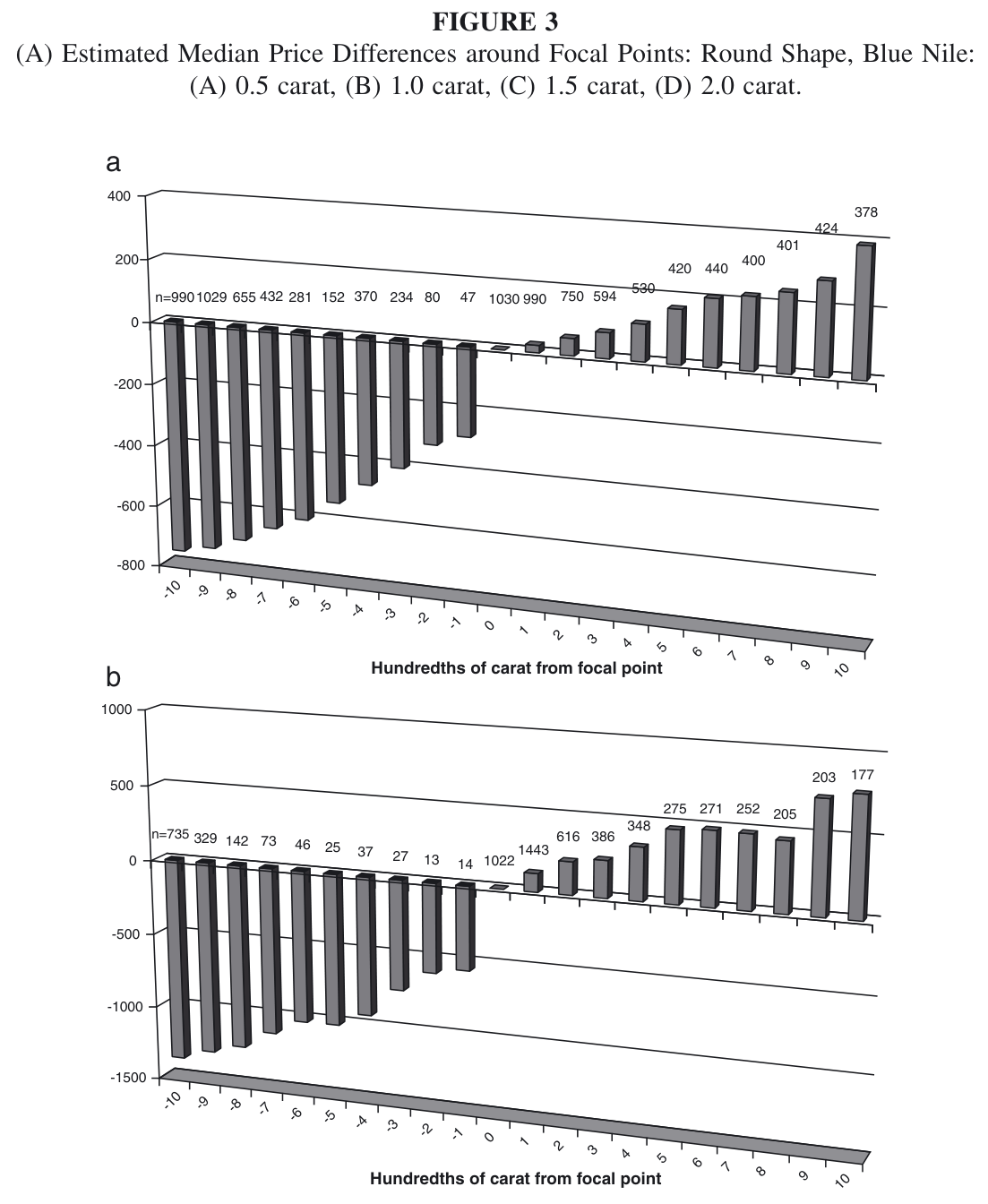
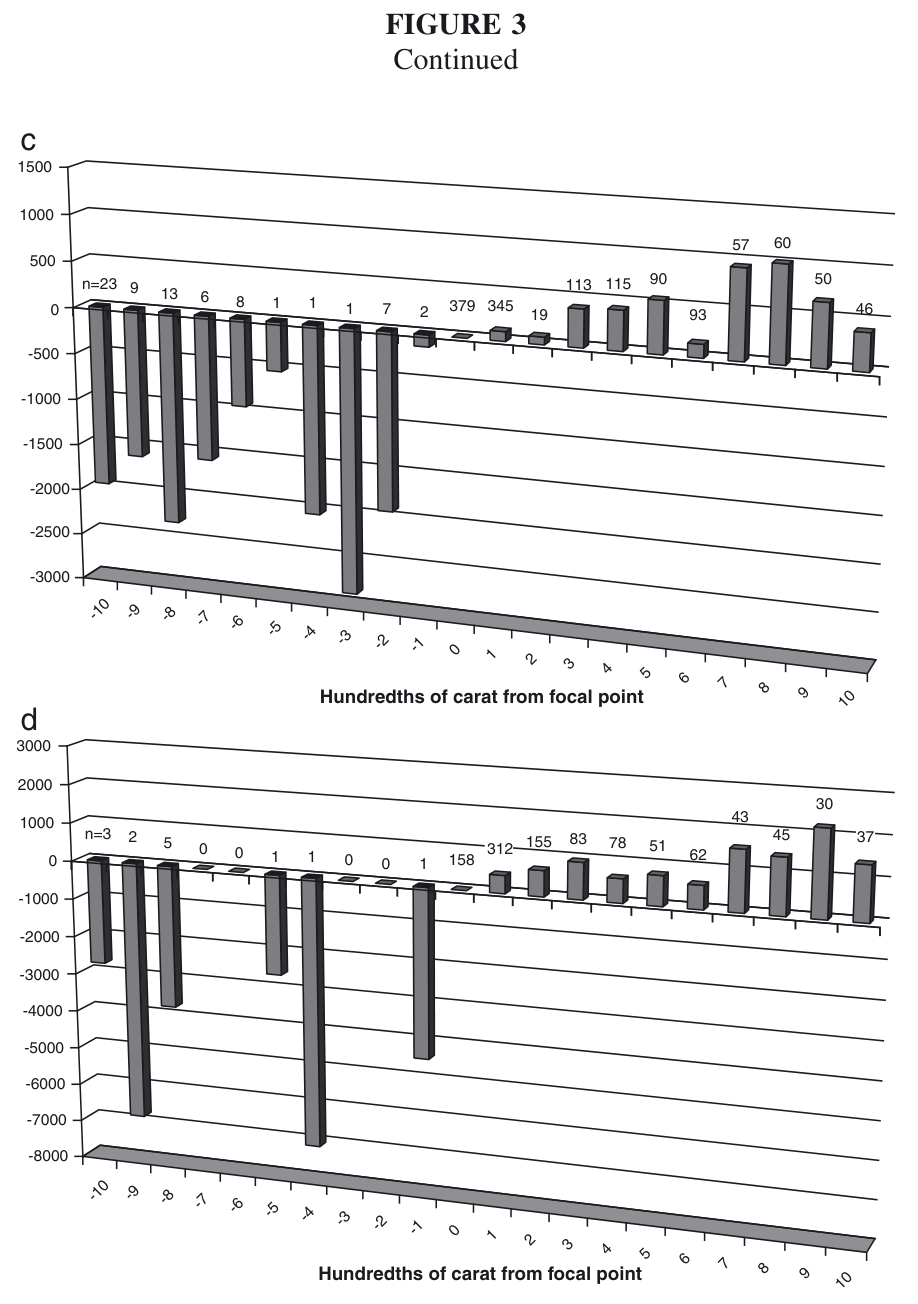
An alternative specification of the regression equation illustrates the dollar magnitude of a larger diamond’s status appeal. We use quantile regressions of price in dollars on the same set of color, clarity, and cut categorical variables, along with dummy variables for each hundredth of a carat size category, for the same four focal point neighborhoods.<sup id="printed-note-ref-27"><a href="#printed-note-27" role="doc-noteref" aria-label="Note 27">27</a></sup> Using dummy variables to identify the nature of the relationship between carat weight and price is less constraining than the specification in our first set of regressions. The effects of color, clarity, and cut mimic the results from the earlier specification. The primary results concerning the relationship between carat weight and price are illustrated in Figures 3A–3D.

The results are striking. The general trend in the relationship between carat weight and price is evident, but there are distinct differences above and below the focal point sizes. In Blue Nile’s inventory, for example, one-hundredth of a carat difference on the low side of 0.50 carats reduces price by $281, while on the high side such a difference increases price by $23, an order of magnitude smaller. Price declines by $554 when going from 1.00 to 0.99 carats but only increases by $120 when weight increases from 1.00 to 1.01 carats. Both sets of coefficient estimates are statistically significant. In the 1.50- and 2.00-carat neighborhoods, small sample sizes on the low side of the focal point make estimation imprecise, but clear differences still exist. The estimated price differential between a 1.50-carat diamond and the 71 diamonds weighing between 1.40 and 1.49 carats is $1,580, while the estimated differential with the 1,163 diamonds weighing between 1.51 and 1.60 carats is $467. The estimated price differential between a 2.00-carat diamond and the 13 diamonds weighing between 1.90 and 1.99 carats is $4,552, while the estimated differential with the 896 diamonds weighing between 2.01 and 2.10 carats is $1,061. Clearly, there is a sizable premium associated with owning a diamond at or above a focal point.

## V. ALTERNATIVE EXPLANATIONS FOR THE OBSERVED ANOMALY

The observed pricing anomaly at focal point sizes presents a puzzle. The retail market for diamonds is clearly competitive on both buyer and seller sides, and information is readily available to all parties. The observed price differences would seem to represent a market equilibrium because there are sizeable monetary incentives for entrepreneurial buyers and sellers to arbitrage any disequilibrium price differences.<sup id="printed-note-ref-28"><a href="#printed-note-28" role="doc-noteref" aria-label="Note 28">28</a></sup> Consumers clearly prefer larger diamonds to smaller diamonds, but the price jumps at focal point sizes indicate that something more than two-thousandths of a gram in weight differentiates a 0.49-carat diamond from a 0.50-carat one.

### Figure 3. (A) Estimated Median Price Differences around Focal Points: Round Shape, Blue Nile: (A) 0.5 carat, (B) 1.0 carat, (C) 1.5 carat, (D) 2.0 carat

<figure><a href="/files/publications/ay-ja-t35tuokg5odv5gob-assets/object-09-page-12.png"><img alt="Figure 3, panels A and B. Estimated median price differences around 0.5- and 1.0-carat focal points for round Blue Nile diamonds. Bars show price differences by hundredths of a carat below and above each focal point, with observation counts." height="1344" loading="lazy" src="/files/publications/ay-ja-t35tuokg5odv5gob-assets/object-09-page-12.png" width="1103"/></a><figcaption>Figure 3. (A) Estimated Median Price Differences around Focal Points: Round Shape, Blue Nile: (A) 0.5 carat, (B) 1.0 carat, (C) 1.5 carat, (D) 2.0 carat — source page 12, part 1 of 2. <a href="/files/publications/ay-ja-t35tuokg5odv5gob-assets/object-09-page-12.png">Open full-resolution image</a> · <a href="/files/publications/ay-ja-t35tuokg5odv5gob.pdf#page=12">Read source PDF page</a></figcaption></figure>
<figure><a href="/files/publications/ay-ja-t35tuokg5odv5gob-assets/object-09-page-13.png"><img alt="Figure 3, continued, panels C and D. Estimated median price differences around 1.5- and 2.0-carat focal points for round Blue Nile diamonds. Bars below the focal points are substantially negative; observation counts are printed above the bars." height="1304" loading="lazy" src="/files/publications/ay-ja-t35tuokg5odv5gob-assets/object-09-page-13.png" width="918"/></a><figcaption>Figure 3. (A) Estimated Median Price Differences around Focal Points: Round Shape, Blue Nile: (A) 0.5 carat, (B) 1.0 carat, (C) 1.5 carat, (D) 2.0 carat — source page 13, part 2 of 2. <a href="/files/publications/ay-ja-t35tuokg5odv5gob-assets/object-09-page-13.png">Open full-resolution image</a> · <a href="/files/publications/ay-ja-t35tuokg5odv5gob.pdf#page=13">Read source PDF page</a></figcaption></figure>

**Caption:** (A) Estimated Median Price Differences around Focal Points: Round Shape, Blue Nile: (A) 0.5 carat, (B) 1.0 carat, (C) 1.5 carat, (D) 2.0 carat.

One possible explanation of the pricing anomaly is that there is a whole-number effect, that is, consumers perceive that there is a categorical difference between diamonds smaller than a carat and one carat or larger. The observed size distribution and resultant pricing of diamonds in some ways resemble the 99% pricing phenomenon. If consumers perceive a distinct difference between items priced at $0.99 and $1.00, perhaps they also perceive a categorical difference between 0.99- and 1.00-carat diamonds. Diamond sellers could exploit such a perception by charging a price premium at the whole-number break. There is obviously something to this explanation because consumers can save hundreds of dollars by buying a diamond imperceptibly smaller than a carat, yet we see very few 0.98- and 0.99-carat diamonds offered for sale.

A second possible explanation is that consumers use rule-of-thumb decision rules, such as “I’m looking for a diamond that is at least one carat.” Such shortcuts would introduce an artificial jump in demand at 1.0 carat with a commensurate jump in price. Such behavior might entice a jeweler in a bricks-and-mortar setting to show the customer only 1.0-carat and larger diamonds, tacking on a price premium for the truncated preferences revealed by the customer. With online sellers, however, buyers are initially prompted to suggest a price range, and diamonds on both sides of focal points are displayed. Customers are then able to specify color, clarity, and cut parameters, which then makes obvious the price premium attached to being on the high side of a round-number size. A consumer who persists in a truncated search at that point must do so because having a diamond that is at least one carat matters to the consumer.

Still another possibility is that diamonds may be purchased as an asset or store of value.

Diamonds are durable and have an extremely high value-to-weight ratio and are traded all over the globe. Perhaps, a 1.00-carat diamond is more liquid than a 0.99-carat one, in that more one-carat stones are offered for sale than 0.99 ones, and this leads to a sharp break in the price continuum at one carat. As Spar (2006) points out, however, De Beers very actively discourages speculators from dabbling in diamonds because it does not want diamonds to be seen as or purchased for anything other than precious sentimental gifts. So De Beers has intentionally increased the risk of holding diamonds as an asset when it has perceived that such speculation is occurring. Since the large majority of diamonds are purchased for jewelry and not as financial assets, the price differences that we observe must be due to something else.

While each of the previous explanations has some merit, none incorporates the aspect of diamonds that economists seem to think sets them apart from ordinary goods. Interpersonal effects on utility have long been recognized—some goods are consumed not just for their intrinsic utility but also for the impression their consumption has on others. Veblen (1899) described such behavior as conspicuous consumption. Leibenstein (1950) further refined the analysis with his concepts of bandwagon, snob, and Veblen effects. Hirsch (1976) and Frank (1985) formally introduced the notion of positional goods into the utility function. Ireland (1994) pointed out the importance of visibility to others if the consumption of a good is to confer status. Becker, Murphy, and Werning (2005) suggest that, in the absence of explicit markets for status, trade in goods like diamonds and gold may implicitly provide a market for social status.

One problem that arises with diamonds is that ownership may be difficult to observe reliably, which as Glazer and Konrad (1996) point out may ruin their use as a signal of status. It is very easy to purchase and wear an artificial diamond and then to misrepresent its authenticity to casual acquaintances. Likewise, it is a small exaggeration to describe a 0.98-carat diamond engagement ring as having a one-carat stone. Glazer and Konrad stress that it is important to determine the target peer group when trying to understand consumption decisions involving status goods. They analyze donations to higher education. University fund-raising campaigns regularly take steps to promote observability and create focal points. Universities group donors by size category and publicize contributions in alumni magazines, recognizing that the size of a person’s contribution signals to former classmates the success they have achieved in life.<sup id="printed-note-ref-29"><a href="#printed-note-29" role="doc-noteref" aria-label="Note 29">29</a></sup> A major part of the market for larger gem-quality diamonds is engagement rings. Prospective grooms typically purchase engagement rings in close consultation with their fiancées. Thus, the target peer group when the prospective groom is making the purchase decision is his fiancée and by extension any friends and family she chooses to confide in. As Brinig (1990) and Tushnet (1998) point out, the engagement ring has both symbolic and real values as a signal of commitment to a long-term relationship.<sup id="printed-note-ref-30"><a href="#printed-note-30" role="doc-noteref" aria-label="Note 30">30</a></sup> Hence, the demand for diamonds will have an intrinsic component that stems from the utility derived from wearing a pretty ring. But, it will also serve as a bond posted by the groom to signal his commitment to the relationship.

The fundamentals of the engagement ring purchase are captured in Bernheim’s (1994) model of conformism, in which individuals care about status as well as intrinsic utility when making consumption decisions. In Bernheim’s model, status depends on others’ perceptions of the individual’s predispositions, which are unobservable. Individuals’ actions signal their predispositions and therefore affect status. In our case, the individual in question is the prospective groom, who wants to be perceived by his fiancée, and perhaps by her family and close friends, as a good marital prospect. The prospective groom signals his type by taking an action—buying an engagement ring. The status accorded to the groom is affected by his action, that is, how big a diamond ring he buys.

In Bernheim’s model, individuals are assumed to have different underlying preferences regarding the intrinsic utility derived from consuming the good. When the status component associated with consumption of the good is sufficiently important relative to intrinsic utility, however, Bernheim shows that individuals may try to conform to a single standard of behavior, which is often established at a focal point. Esteem is a discontinuous function of action, in that individuals are penalized significantly for any deviation, no matter how small, from the social norm.<sup id="printed-note-ref-31"><a href="#printed-note-31" role="doc-noteref" aria-label="Note 31">31</a></sup>

Diamond rings fit this model well. Since a difference of a few hundredths of a carat is physically difficult to detect, the difference in intrinsic utility between two similarly sized diamonds will be fairly small. This is supported by the relatively small difference in market price, for example, between 0.93- and 0.95-carat diamonds. But, suppose that society’s perception function is discontinuous at the focal point size of 1.00 carat, such that prospective grooms who buy one-carat or larger diamond rings for their fiancées are perceived to be type _W_ and those who buy rings smaller than a carat are perceived to be type _L_. Status utility will take a discrete jump between 0.99 and 1.00 carats, which is consistent with our empirical estimates of diamond prices.

Bernheim’s model accommodates the “whole-number effect” nicely. Whole numbers provide a natural focal point to which individuals can conform. By buying a diamond on the high side of a focal point, a prospective groom takes an action that causes his fiancée to perceive him as a good marital prospect, and for that reason there is a categorical difference between a 0.99- and a 1.00-carat diamond. This explanation is perhaps more satisfying than arguing that consumers perceive the actual size difference between a 0.98 and a 0.99-carat diamond to be worth around $100 and the actual size difference between a 0.99- and a 1.00-carat diamond to be worth over $500, simply because they are confused by whole numbers. Rule-of-thumb purchasing decisions are also accommodated within

Bernheim’s model. A groom who wants to signal that he is type _W_ and not type _L_ will ask the jeweler to show him and his fiancée only diamonds that are one carat or larger. It is the desire to influence his fiancée’s perception of him that makes him willing to pay the premium for a truncated search.

Finally, why don’t consumers simply lie about the size of their diamonds? As a practical matter, lying is not an option for the many prospective grooms who are accompanied by their fiancées when picking out an engagement ring. And in those cases where the groom buys the ring without prior consultation with the prospective bride, jewelers provide certification papers on diamonds that clearly indicate carat weight and other characteristics, which the married couple then keep alongside other important household documents. Perhaps most importantly, given the importance of the signaling function that the size of the engagement ring serves, the downside risk to lying is enormous.

## VI. SUMMARY AND CONCLUSIONS

Because they are consumed not only for their intrinsic utility but also for the impression their consumption has on other people, diamonds are not the typical economic good. Separating these two effects is possible for diamonds because nature introduces exogeneity in the supply process that allows us to identify the intrinsic value consumers place on a slightly larger diamond. We collect data on diamond prices and other attributes from three large online diamond merchants and empirically analyze the determinants of price. We find sharp differences in diamond prices at half- and whole-carat sizes, which are not explainable by other characteristics of the diamond. For diamonds in the one-carat range, for example, owning a diamond that is one carat rather than 0.99

carats carries a 5%–10% price premium.

It is possible that the observed pricing anomaly occurs because there is a whole-number effect or because consumers use rule-of-thumb decision rules. While both are plausible, the magnitude of the dollar amounts involved suggests that something else is also at work. Bernheim’s (1994) model of conformism, where individuals care about status as well as intrinsic utility, fits the diamond example well. Status depends on other people’s perceptions of an individual’s predispositions. A groom is able to influence his fiancée’s perception of his desirability as a spouse by the size of the diamond engagement ring that he buys. In Bernheim’s model, individuals may try to conform to a single standard of behavior, which because of whole-number effects or rule-of-thumb decision rules may get established at focal point sizes like half and whole carats. The sizable jumps in price that we observe at focal point sizes may occur because a 1.00-carat diamond creates a categorically different perception for a bride-to-be than a 0.99-carat stone.

Theoretical analyses of status-seeking behavior are plentiful.<sup id="printed-note-ref-32"><a href="#printed-note-32" role="doc-noteref" aria-label="Note 32">32</a></sup> Other authors offer generous anecdotal evidence of status good effects; however, empirical analyses that attempt to identify conspicuous consumption behavior are scarce.<sup id="printed-note-ref-33"><a href="#printed-note-33" role="doc-noteref" aria-label="Note 33">33</a></sup> Identifying status effects is difficult in practice because the goods are often of higher quality, which may be hard to measure. Our data set, however, allows us to control carefully for quality differences in diamonds. It is important to note that the status effect that we identify is of a somewhat different nature than many types of conspicuous consumption. A groom buys a diamond engagement ring to influence the perceptions of his fiancée and perhaps her family and close friends. Mansions and luxury automobiles are much more effective status signals if the target audience is the general public.

## References

- Bagwell, L. S., and B. D. Bernheim. “Veblen Effects in a Theory of Conspicuous Consumption.” _American Economics Review_ , 86, 1996, 349–73.

- Basmann, R. L., D. J. Molina, and D. J. Slottje. “A Note on Measuring Veblen’s Theory of Conspicuous Consumption.” _The Review of Economics and Statistics_ , 70, 1988, 531–35.

- Becker, G. S., K. M. Murphy, and I. Werning. “The Equilibrium Distribution of Income and the Market for Status.” _Journal of Political Economy_ , 113, 2005, 282–310.

- Bernheim, D. B. “A Theory of Conformity.” _Journal of Political Economy_ , 102, 1994, 841–77.

- Brinig, M. F. “Rings and Promises.” _Journal of Law, Economics, and Organization_ , 6, 1990, 203–15.

- Cockburn, A. “Diamonds: The Real Story.” _National Geographic_ , 201, 2002, 2–35.

- Corneo, G., and O. Jeanne. “Conspicuous Consumption, Snobbism, and Conformism.” _Journal of Public Economics_ , 66, 1997, 55–71.

- Glazer A., and K. A. Konrad. “A Signaling Explanation for Charity.” _American Economic Review_ , 86, 1996, 1019–28.

- Frank, R. H. “The Demand for Unobservable and Other Nonpositional Goods.” _American Economic Review_ , 75, 1985, 101–16.

- Harbaugh, W. T. “The Prestige Motive for Making Charitable Transfers.” _American Economic Review_ , 88, 1998a, 277–82.

- Harbaugh, W. T. “What Do Donations Buy? A Model of Philanthropy Based on Prestige and Warm Glow.” _Journal of Public Economics_ , 67, 1998b, 269–84.

- Heffetz, O. “Conspicuous Consumption and the Visibility of Consumer Expenditures.” Working Paper, Cornell University, February 2006.

- Hirsch, F. _Social Limits to Growth_ . Cambridge, MA: Harvard University Press, 1976.

- Hopkins, E., and T. Kornienko. “Running to Keep in the Same Place: Consumer Choice as a Game of Status.” _American Economic Review_ , 94, 2004, 1085–107.

- Ireland, N. J. “On Limiting the Market for Status Signals.” _Journal of Public Economics_ , 53, 1994, 91–110.

- Ireland, N. J. “Optimal Income Tax in the Presence of Status Effects.” _Journal of Public Economics_ , 81, 2001, 193–212.

- Liebenstein, H. “Bandwagon, Snob, and Veblen Effects in the Theory of Consumers’ Demand.” _Quarterly Journal of Economics_ , 64, 1950, 183–207.

- Ng, Y.-K. “Diamonds are a Government’s Best Friend: Burden-Free Taxes on Goods Valued for their Values.” _American Economics Review_ , 77, 1987, 186–91.

- O’Connell, V. “Gem War.” _Wall Street Journal_ , 13 January 2007, P1.

- Passariello, C. “European Jewelers Engage in Global Battle for Brides.” _Wall Street Journal_ , 3 August 2007, B1.

- Richman, B. D. “Community Enforcement of Informal Contracts: Jewish Diamond Merchants in New York.” Harvard John M. Olin Discussion Paper Series, 384, 2002.

- Spar, D. L. “Continuity and Change in the International Diamond Market.” _Journal of Economic Perspectives_ , 20, 2006, 195–208.

- Tushnet R. “Rules of Engagement.” _Yale Law Journal_ , 107, 1998, 2583–618.

- Veblen, T. _The Theory of the Leisure Class_ . New York: Macmillan, 1899.

- White, M. V. “Doctoring Adam Smith: The Fable of the Diamonds and Water Paradox.” _History of Political Economy_ , 34, 2002, 659–83.

- Yee, B. “Ads Remind Women They Have Two Hands.” _Wall Street Journal_ , 14 August 2003, B1.

- Zimmerman, A. “Diamond Industry Rocked by Allegations of Bribery.” _Wall Street Journal_ , 20 December 2005, A1.

---

## Notes

<p id="printed-note-1" role="doc-endnote" markdown="1"><strong>1.</strong> White (2002) offers a contrarian view of the diamonds—water “paradox.” <a class="footnote-backref" href="#printed-note-ref-1" aria-label="Back to note 1 reference">&#8617;</a></p>

<p id="printed-note-2" role="doc-endnote" markdown="1"><strong>2.</strong> Jewelry ranked 4th of 31 in Heffetz’s (2006) scale of visibility of different categories of consumer expenditures. <a class="footnote-backref" href="#printed-note-ref-2" aria-label="Back to note 2 reference">&#8617;</a></p>

<p id="printed-note-3" role="doc-endnote" markdown="1"><strong>3.</strong> Spar (2006) also discusses the ingenious marketing campaigns that De Beers has used over time to manage consumer perceptions and hence the demand for diamond jewelry. <a class="footnote-backref" href="#printed-note-ref-3" aria-label="Back to note 3 reference">&#8617;</a></p>

<p id="printed-note-4" role="doc-endnote" markdown="1"><strong>4.</strong> See the discussion of rings and promises by Brinig (1990) and Tushnet (1998). <a class="footnote-backref" href="#printed-note-ref-4" aria-label="Back to note 4 reference">&#8617;</a></p>

<p id="printed-note-5" role="doc-endnote" markdown="1"><strong>5.</strong> Spar (2006) summarizes the history and evolution of the international diamond market. <a class="footnote-backref" href="#printed-note-ref-5" aria-label="Back to note 5 reference">&#8617;</a></p>

<p id="printed-note-6" role="doc-endnote" markdown="1"><strong>6.</strong> For an illustrative (and illustrated) description of the supply chain from mining to wholesaling and distribution, see Cockburn (2002). Richman (2002) provides a detailed discussion of the social and economic institutions surrounding the cutting, polishing, and trading of wholesale diamonds. <a class="footnote-backref" href="#printed-note-ref-6" aria-label="Back to note 6 reference">&#8617;</a></p>

<p id="printed-note-7" role="doc-endnote" markdown="1"><strong>7.</strong> Cockburn (2002, 20). <a class="footnote-backref" href="#printed-note-ref-7" aria-label="Back to note 7 reference">&#8617;</a></p>

<p id="printed-note-8" role="doc-endnote" markdown="1"><strong>8.</strong> The sales pitch made for diamonds by online sellers like Blue Nile and Union and by bricks-and-mortar jewelry stores always starts with an explanation of the four C’s. The importance of the four C’s in determining value is validated by the high values of _R_<sup>2</sup> in our cross-sectional regressions, which are on the order of 0.80–0.90. <a class="footnote-backref" href="#printed-note-ref-8" aria-label="Back to note 8 reference">&#8617;</a></p>

<p id="printed-note-9" role="doc-endnote" markdown="1"><strong>9.</strong> For an explanation and illustration of reflection and refraction of light within a prism and the perceived effect on brilliance, see http://www.bluenile.com. <a class="footnote-backref" href="#printed-note-ref-9" aria-label="Back to note 9 reference">&#8617;</a></p>

<p id="printed-note-10" role="doc-endnote" markdown="1"><strong>10.</strong> The production of synthetic diamonds has become so sophisticated that even experts can have trouble distinguishing between natural and synthetic stones. See O’Connell (2007). <a class="footnote-backref" href="#printed-note-ref-10" aria-label="Back to note 10 reference">&#8617;</a></p>

<p id="printed-note-11" role="doc-endnote" markdown="1"><strong>11.</strong> Spar (2006) states that “De Beers told its (mostly male) customers how to buy these talismans of love: several months’ salary was the recommended price, with attention duly paid to the cartel’s own criteria of color, cut, clarity, and carat.” By 1965, 80% of all brides were choosing diamond engagement rings (Brinig 1990). <a class="footnote-backref" href="#printed-note-ref-11" aria-label="Back to note 11 reference">&#8617;</a></p>

<p id="printed-note-12" role="doc-endnote" markdown="1"><strong>12.</strong> See Passariello (2007). <a class="footnote-backref" href="#printed-note-ref-12" aria-label="Back to note 12 reference">&#8617;</a></p>

<p id="printed-note-13" role="doc-endnote" markdown="1"><strong>13.</strong> As Yee (2003) explains, “for women who want to wear diamonds, husbands and fiancées are no longer required.” <a class="footnote-backref" href="#printed-note-ref-13" aria-label="Back to note 13 reference">&#8617;</a></p>

<p id="printed-note-14" role="doc-endnote" markdown="1"><strong>14.</strong> The diamonds in both Blue Nile’s and Union’s inventories are certified by either the Gemological Institute of America (GIA) or the American Gem Society Laboratories. Amazon also uses the International Gemological Institute. There was a recent allegation of bribery of several of GIA’s graders, but apparently the incident was restricted to a limited number of high-end jewels evaluated by GIA’s New York laboratory for a few specific merchants. See Zimmerman (2005) for details. <a class="footnote-backref" href="#printed-note-ref-14" aria-label="Back to note 14 reference">&#8617;</a></p>

<p id="printed-note-15" role="doc-endnote" markdown="1"><strong>15.</strong> Blue Nile (and Union, as well) assigns each diamond in its inventory a unique identification number, so we can track diamonds over time. There is regular turnover in Blue Nile’s inventory. It does adjust prices on some diamonds from time to time, but price changes are typically fairly small. <a class="footnote-backref" href="#printed-note-ref-15" aria-label="Back to note 15 reference">&#8617;</a></p>

<p id="printed-note-16" role="doc-endnote" markdown="1"><strong>16.</strong> See www.bluenile.com for illustrations of each of these shapes. <a class="footnote-backref" href="#printed-note-ref-16" aria-label="Back to note 16 reference">&#8617;</a></p>

<p id="printed-note-17" role="doc-endnote" markdown="1"><strong>17.</strong> On the other hand, if size were completely endogenous, we would expect to see spikes at round number sizes, with nothing in between. That is why it is not possible to buy a 0.87-carat cubic zirconium ring. <a class="footnote-backref" href="#printed-note-ref-17" aria-label="Back to note 17 reference">&#8617;</a></p>

<p id="printed-note-18" role="doc-endnote" markdown="1"><strong>18.</strong> Blue Nile has one thousand twenty-two 1.00-carat diamonds and one thousand four hundred and forty-three 1.01-carat diamonds in its inventory, which indicates that diamond cutting is not an exact science and that risk aversion apparently affects diamond cutters’ decisions. <a class="footnote-backref" href="#printed-note-ref-18" aria-label="Back to note 18 reference">&#8617;</a></p>

<p id="printed-note-19" role="doc-endnote" markdown="1"><strong>19.</strong> An interesting exception occurs in the Union Diamond Co. sample that we collected in July 2005. Union’s inventory of 0.99 round diamonds ( _n_ = 78) was almost an order of magnitude larger than it has been at any other time since we originally collected the data. Also, as is evident in Figure 2B, the average price of these 0.99-carat diamonds ($5,004) differs only slightly and is not statistically significantly different from that of Union’s 1.00-carat diamonds ($5,437). It almost appears that Union was conducting a market experiment at the time to see if it could acquire a larger inventory of 0.99-carat stones and profit from the pricing anomaly that we have uncovered. This strategy apparently was not profitable for Union, because it has since sharply reduced the number of 0.99-carat diamonds that it carries, and its prices now display the same pattern that Blue Nile’s and Amazon’s prices do. <a class="footnote-backref" href="#printed-note-ref-19" aria-label="Back to note 19 reference">&#8617;</a></p>

<p id="printed-note-20" role="doc-endnote" markdown="1"><strong>20.</strong> The prices of Blue Nile’s diamonds exceed those of Union and Amazon in almost every size category, which may reflect quality differences or reputational effects. See Footnote 25 for further discussion. <a class="footnote-backref" href="#printed-note-ref-20" aria-label="Back to note 20 reference">&#8617;</a></p>

<p id="printed-note-21" role="doc-endnote" markdown="1"><strong>21.</strong> Regression results for the other shapes are very similar to those for round diamonds reported here. We also tried cubic and quartic specifications for carat weight, and results were essentially unchanged. Finally, we analyzed minor focal points (0.7, 0.9, and 1.2 carats) as well and found significant price differences above and below the focal point cutoffs similar to those reported in Tables 3–6. <a class="footnote-backref" href="#printed-note-ref-21" aria-label="Back to note 21 reference">&#8617;</a></p>

<p id="printed-note-22" role="doc-endnote" markdown="1"><strong>22.</strong> The regressions that underlie Figure 3 contain dummy variables for each hundredth of a carat weight and so do not restrict the shape of the carat weight-price relationship. These diagrams confirm that the discontinuities occur just below the round number sizes. <a class="footnote-backref" href="#printed-note-ref-22" aria-label="Back to note 22 reference">&#8617;</a></p>

<p id="printed-note-23" role="doc-endnote" markdown="1"><strong>23.</strong> There were only 69 observations for Amazon in the 2.0-carat neighborhood, and we were unable to estimate a model with the focal point dummy variable, carat weight, and its square. <a class="footnote-backref" href="#printed-note-ref-23" aria-label="Back to note 23 reference">&#8617;</a></p>

<p id="printed-note-24" role="doc-endnote" markdown="1"><strong>24.</strong> Trend = 10 for carat = 0.49 and trend = 11 for carat = 0.50. We scale trend-squared by dividing by 100, so the respective values for trend-squared are 1.00 and 1.21. Multiplying each of these by the estimated regression coefficients for trend (0.049) and trend-squared (−0.91) and calculating the difference indicates that log (price) increases by 0.03 when carat weight changes from 0.49 to 0.50. <a class="footnote-backref" href="#printed-note-ref-24" aria-label="Back to note 24 reference">&#8617;</a></p>

<p id="printed-note-25" role="doc-endnote" markdown="1"><strong>25.</strong> When we pool the data across retailers and include dummy variables for each retailer, our results are essentially unchanged. We do find that in July 2005 when we collected our data, Blue Nile was able to exploit its position as online market pioneer and leader to the tune of between 7% and 10% for each size grouping. We are currently exploring whether this premium has dissipated over time as the online market has matured. We are grateful to the referee for this suggestion. <a class="footnote-backref" href="#printed-note-ref-25" aria-label="Back to note 25 reference">&#8617;</a></p>

<p id="printed-note-26" role="doc-endnote" markdown="1"><strong>26.</strong> That observable characteristics of diamonds explain such a high percentage of the variation in price suggests that unobservable differences between diamonds above and below focal points are not causing the discontinuities in price we observe. <a class="footnote-backref" href="#printed-note-ref-26" aria-label="Back to note 26 reference">&#8617;</a></p>

<p id="printed-note-27" role="doc-endnote" markdown="1"><strong>27.</strong> The excluded size categories are the focal points themselves, 0.50, 1.00, 1.50, and 2.00 carats. We use quantile regressions out of concern over outliers. The same pattern substantively holds when we use OLS. <a class="footnote-backref" href="#printed-note-ref-27" aria-label="Back to note 27 reference">&#8617;</a></p>

<p id="printed-note-28" role="doc-endnote" markdown="1"><strong>28.</strong> Jewelers often bundle several diamonds into one piece of jewelry and then report the total carat weight. Thus, a 0.96 stone can be combined with two 0.52 stones in an “anniversary ring” that is marketed as a two-carat ring. This ability to bundle serves to mitigate the price discontinuity that we observe. <a class="footnote-backref" href="#printed-note-ref-28" aria-label="Back to note 28 reference">&#8617;</a></p>

<p id="printed-note-29" role="doc-endnote" markdown="1"><strong>29.</strong> Harbaugh (1998a, 1998b) demonstrates that donors who care not only about warm-glow effects but also about prestige effects can be induced to increase their giving by establishing appropriate brackets and then publicizing the names of donors falling into each bracket. And the actual distribution of contributions displays the same sort of discontinuities observed in solitaire diamonds. <a class="footnote-backref" href="#printed-note-ref-29" aria-label="Back to note 29 reference">&#8617;</a></p>

<p id="printed-note-30" role="doc-endnote" markdown="1"><strong>30.</strong> Tushnet (1998) explains that the law recognizes this commitment role for engagement rings in the promise to marry, and so they get different treatment than other gifts. If the marriage ceremony occurs, the ring becomes the property of the bride. In the event of failure to marry, the engagement ring is returned to the male donor. <a class="footnote-backref" href="#printed-note-ref-30" aria-label="Back to note 30 reference">&#8617;</a></p>

<p id="printed-note-31" role="doc-endnote" markdown="1"><strong>31.</strong> That society discontinuously censures deviations from the norm is an outcome and not an assumption of the model. See Bernheim (1994, 860). <a class="footnote-backref" href="#printed-note-ref-31" aria-label="Back to note 31 reference">&#8617;</a></p>

<p id="printed-note-32" role="doc-endnote" markdown="1"><strong>32.</strong> In addition to other articles cited, Bagwell and Bernheim (1996) examine conditions under which Veblen effects can arise. Corneo and Jeanne (1997) concentrate on consumption when the conspicuous good is indivisible. Ireland (2001) evaluates the optimal income tax when status effects are present. Hopkins and Kornienko (2004) model consumer choice as a game of status, where status depends on relative position in society. <a class="footnote-backref" href="#printed-note-ref-32" aria-label="Back to note 32 reference">&#8617;</a></p>

<p id="printed-note-33" role="doc-endnote" markdown="1"><strong>33.</strong> Two studies that use aggregate consumption data on broad classes of expenditures to draw general inferences about conspicuous consumption are Basmann, Molina, and Slottje (1988) and Heffetz (2006). <a class="footnote-backref" href="#printed-note-ref-33" aria-label="Back to note 33 reference">&#8617;</a></p>